

Coagulation factor XIa (FXIa) is a key protease in the intrinsic coagulation pathway and plays a central role in pathological thrombosis, while having minimal impact on normal hemostasis. It is therefore considered a safe target for developing next-generation anticoagulant drugs.
Recently, a research team from the Institute of Oceanology, Chinese Academy of Sciences, made progress in the discovery of anticoagulant peptides. The team identified a decapeptide, KDETRTPEEL, from cold-seep mussels in the South China Sea that selectively inhibits FXIa, and systematically characterized its anticoagulant activity, target selectivity, mechanism of action, and in vivo antithrombotic effects.
Using cold-seep mussels from the South China Sea as raw material, the researchers prepared oligopeptide hydrolysates (GPk) via proteinase K hydrolysis. Through activity-guided separation, high-resolution mass spectrometry identification, and cross-validation with AI tools, they screened 96 high-confidence candidate structures from over 5,000 peptide sequences and selected 20 peptides for activity validation. Experiments showed that 8 peptides significantly inhibited FXIa activity, with a hit rate of 40%.
Among them, the deep-sea mussel-derived decapeptide KDETRTPEEL exhibited the strongest inhibitory activity against FXIa, while showing weak effects on other coagulation-related enzymes in the same family, indicating good overall selectivity. The peptide was identified as a non-competitive inhibitor of FXIa, suggesting that its binding site may differ from that of traditional substrates. AF3 and molecular dynamics simulations revealed that the binding of the peptide to FXIa is primarily driven by electrostatic interactions, with charged residues on the peptide forming stable salt bridges and electrostatic complementary pairs with the FXIa active pocket. In contrast, the corresponding electrostatic environment is absent in the active sites of other coagulation-related enzymes such as FXIIa, resulting in significantly lower binding energy than that of FXIa, thereby explaining the target preference of the peptide at the energetic level. Furthermore, computational predictions combined with site-directed mutagenesis experiments consistently identified several key residues responsible for the FXIa inhibitory effect of the peptide.
In complex plasma environments, KDETRTPEEL preferentially prolonged APTT, with potency more than 16 times higher than that of the previous lead peptide PRNIF, and its in vivo antithrombotic efficacy was validated in a transgenic zebrafish model. This study provides a new paradigm for the efficient discovery of deep-sea bioactive peptide resources and the development of anticoagulant drug leads.
The related research findings were published in Bioresource Technology. This work was supported by the Shandong Provincial Natural Science Foundation and other funding sources.
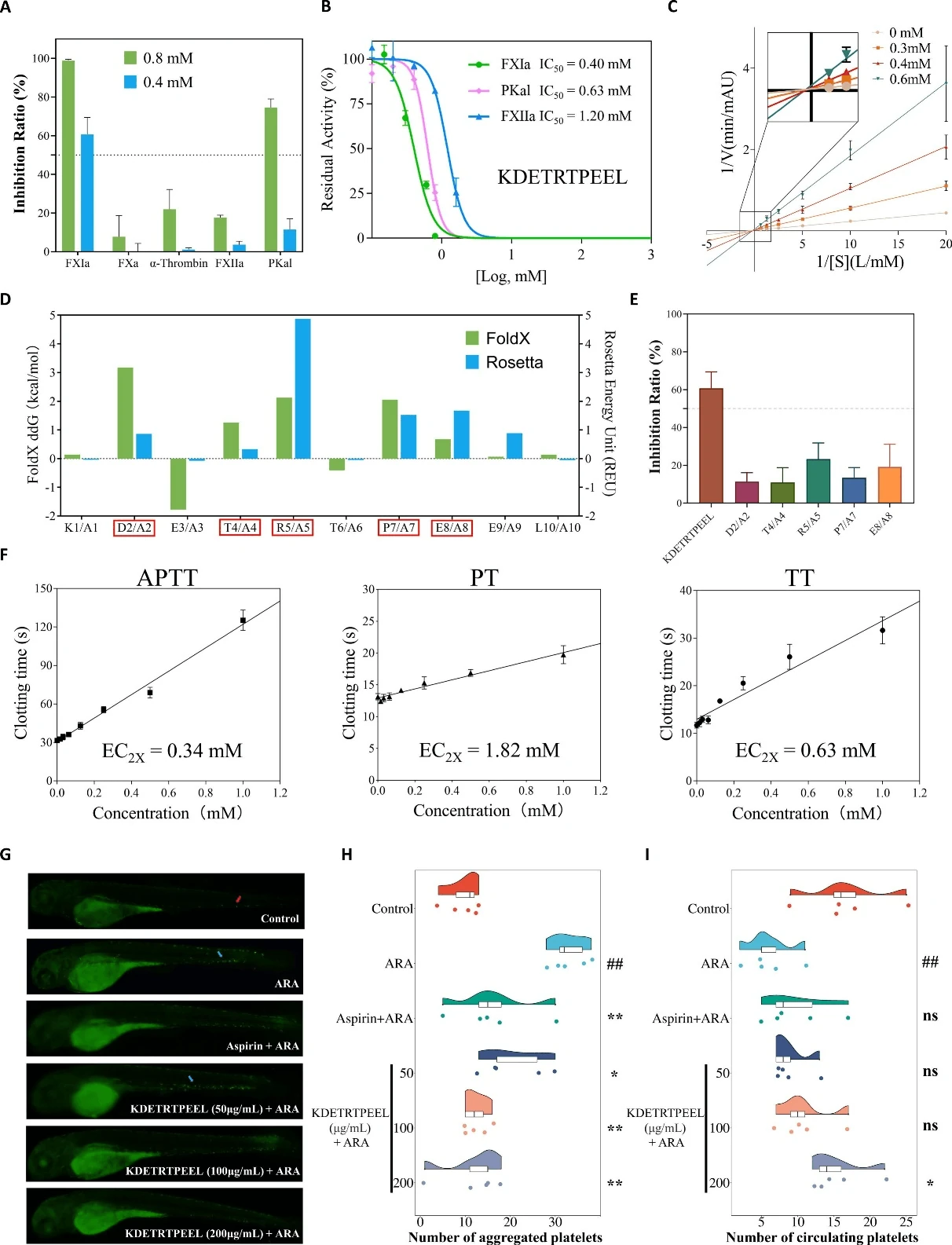
Anticoagulant activity, target selectivity, and in vivo antithrombotic effects of KDETRTPEEL.