

Quick Answer
Therapeutic peptides are medicines based on amino-acid chains that are designed or optimized to interact with specific biological targets. They occupy an important space between many small-molecule drugs and larger biologics.
What Are Therapeutic Peptides?
Therapeutic peptides are a unique class of pharmaceutical agents composed of a series of well-ordered amino acids, usually with molecular weights of 500-5000 Da. Research into therapeutic peptides started with fundamental studies of natural human hormones, including insulin, oxytocin, vasopressin, and gonadotropin-releasing hormone (GnRH), and their specific physiological activities in the human body. Since the synthesis of the first therapeutic peptide, insulin, in 1921, remarkable achievements have been made resulting in the approval of more than 80 peptide drugs worldwide. The development of peptide drugs has thus become one of the hottest topics in pharmaceutical research.
The first half of the 20th century witnessed the discovery of several life-saving bioactive peptides, such as insulin and adrenocorticotrophic hormone, which were initially studied and isolated from natural sources. The discovery and development of insulin, a peptide with 51 amino acids, has been considered as one of the monumental scientific achievements in drug discovery. It was first isolated by Frederick Banting in 1921 and further developed by Frederick and Charles Best, and was already available for patients with diabetes mellitus just a year after its first isolation. In 1923, insulin became the first commercial peptide drug and has since benefited thousands of diabetes patients to date. However, the production of human insulin during the 20th century could not keep up with the high market demand, and animal-derived insulins, such as bovine and porcine insulin, dominated the insulin market for almost 90 years until they were replaced by recombinant insulin.
More peptide hormones and their receptors with therapeutic potential were identified and characterized from the 1950s to the 1990s. Meanwhile, the technologies used for protein purification and synthesis, structure elucidation, and sequencing made substantial progress, thus accelerating the development of peptide drugs, leading to nearly 40 peptide drugs being approved worldwide. Notably, synthetic peptides such as synthetic oxytocin, synthetic vasopressin, and recombinant human insulin began to be developed in addition to natural peptides.
Peptide drug development entered a new era with the advent of the 21st century, since when advances in structural biology, recombinant biologics, and new synthetic and analytic technologies have significantly accelerated the process. A sophisticated system of peptide drug development has been established, including peptide drug discovery, drug design, peptide synthesis, structural modification, and activity evaluation. A total of 33 non-insulin peptide drugs have been approved worldwide since 2000 . In addition, these peptide drugs are no longer simply hormone mimics or composed simply of natural amino acids. For example, enfuvirtide is a 36-amino acid biomimetic peptide mimicking human immunodeficiency virus (HIV) proteins used in combination therapy for the treatment of HIV-1; ziconotide is a neurotoxic peptide derived from the cone snail _Conus magus_, which was approved in 2004 and is used to manage severe chronic pain; teduglutide is a glucagon-like peptide 2 (GLP-2) analogue used to treat short bowel syndrome, and is manufactured using a strain of _Escherichia coli_ modified by recombinant DNA technology; and liraglutide is a chemically synthesized analogue of human glucagon-like peptide 1(GLP-1), made by attaching a C-16 fatty acid (palmitic acid) with a glutamic acid spacer on lysine residue (position 26 in the sequence), which acts as a GLP-1 receptor agonist to manage type 2 diabetes mellitus (T2DM). All these peptide drugs have been used in a wide range of therapeutic areas, such as urology, respiratory, pain, oncology, metabolic, cardiovascular, and antimicrobial applications. To date, more than 170 peptides are in active clinical development, with many more in preclinical studies.
Table 1 Peptide drugs approved since 2000, with their targets and indications
Table 2 Examples of peptides in different clinical trials and their indications
Peptide drugs account for a significant proportion of the pharmaceutical market, with worldwide sales of more than $70 billion in 2019, a more than two-fold increase compared with 2013. According to Njardarson et al., the top 200 drug sales in 2019, included 10 non-insulin peptide drugs. Interestingly, the top three sales of peptide drugs were all GLP-1 analogues for treating T2DM, including Trulicity (dulaglutide) ranked at 19 with $4.39 billion retail sales, Victoza (liraglutide), ranked at 32 with $3.29 billion sales, and Rybelsus (semaglutide), ranked at 83 with $1.68 billion sales.
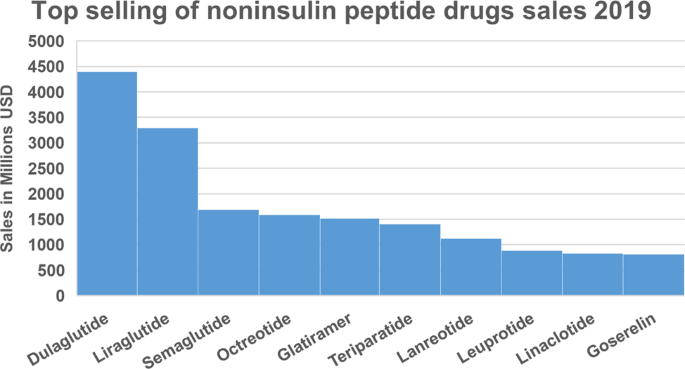
Top-selling non-insulin peptides worldwide in 2019. Data analysis according to Njardarson’s group
In this article, we review the historical development of peptide drugs and current advances in peptide drug discovery. We focus on the pharmaceutical characteristics of therapeutic peptides and highlight new technologies that have improved the design, synthesis, modification, and evaluation of peptide drugs, and provide new perspectives in the applications of peptide drugs. We also refer readers to several recent reviews for further reading.
Key takeaway
Therapeutic peptides are a broad class of medicines rather than a single type of drug. Their development has progressed from naturally occurring hormones to rationally designed, chemically modified, and structurally constrained molecules. This evolution helps explain why peptide science now connects drug discovery, synthetic chemistry, structural biology, biotechnology, and drug-delivery research.
Source & Further Reading
This page is an original educational paraphrase based primarily on:
Wang, L. et al. Therapeutic peptides: current applications and future directions. Signal Transduction and Targeted Therapy 7, 48 (2022).
Read the original open-access review
This page does not reproduce the source article. It is provided for educational and informational purposes and is not medical advice.