

Quick Answer
Peptides can combine high biological specificity with structural flexibility and can be engineered to recognize targets that may be difficult to address with some conventional small molecules. The same molecular properties that make peptides biologically useful can also create development challenges, especially enzymatic degradation, limited membrane permeability, short half-life, formulation complexity, and scale-up.
Advantages of Peptide Therapeutics
Peptide medicines have attracted sustained interest because they combine several useful features of small molecules and biologic therapies. Their value becomes clearer when their molecular size, flexibility, and target interactions are considered together.
High-affinity biological recognition
Therapeutic peptides can interact strongly and selectively with biological targets. The source review notes that many peptides act through cell-surface receptors and can function as hormones, growth-factor-related agents, neurotransmitter-related agents, ion-channel ligands, or anti-infective molecules.
Because peptide sequences contain multiple amino-acid side chains, they can form several simultaneous contacts with a target. This can be useful when a therapeutic strategy depends on recognizing a relatively large or structurally complex surface.
An intermediate modality
Peptides sit between traditional small molecules and large biologics in several respects. Their greater size and flexibility can provide interaction surfaces that are difficult for very small molecules to reproduce, while their smaller scale can simplify some aspects of synthesis and characterization compared with large proteins.
The review specifically discusses protein–protein interactions (PPIs). Many PPIs involve broad molecular interfaces, and peptide structures can sometimes be designed to mimic a portion of a protein interaction surface.
Opportunities for structural optimization
A major advantage of peptide chemistry is the ability to modify the molecular structure deliberately. Researchers can change individual amino acids, alter termini, introduce non-natural residues, cyclize a sequence, or attach chemical groups.
These modifications can be used to pursue different objectives, such as improving stability, binding affinity, selectivity, solubility, or pharmacokinetic behavior. GLP-1 analogues provide a well-known example of how chemical modification can address limitations of a natural peptide.
Lower complexity than many biologics
The review notes that therapeutic peptides can show lower immunogenicity and lower production costs than some larger biologic modalities. This does not mean that peptide manufacturing is simple or inexpensive in every case; rather, peptides occupy a distinct manufacturing space with mature chemical-synthesis technologies and specialized production equipment.
Access to difficult targets
Peptides can be particularly interesting for targets involving protein surfaces and PPIs. Rational peptide design can use structural information to identify important interaction residues, sometimes called hotspots, and then build peptide candidates around these regions.
Macrocyclic and conformationally constrained peptides are another important area. Structural constraints can reduce conformational freedom and may help create molecules that better reproduce a desired target-binding geometry.
Important qualification
Advantages do not eliminate the limitations of peptide drugs. The same review identifies weak membrane permeability and poor in-vivo stability as major intrinsic challenges. Peptide molecules can also require specialized delivery approaches.
Therefore, the practical advantage of a peptide depends on the target, sequence, molecular design, formulation, route of administration, and development stage.
Challenges of Peptide Drugs
Peptides offer strong biological recognition, but their molecular properties also create important development challenges. Two limitations highlighted by Wang et al. are weak membrane permeability and poor in-vivo stability.
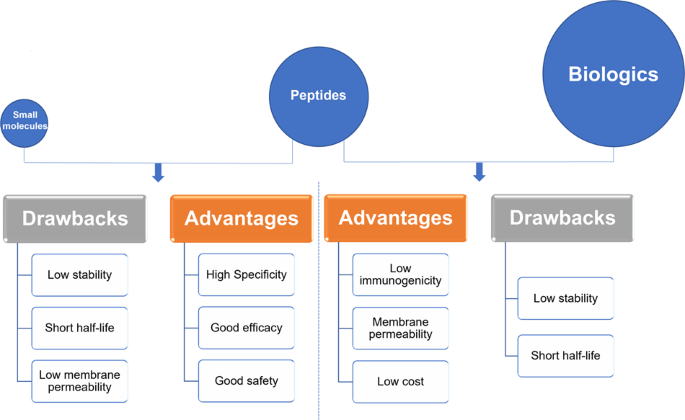
Limited membrane permeability
Many peptide drugs do not readily cross cell membranes. This can make intracellular targets difficult to reach.
The review cites earlier work showing that most peptides in active clinical development targeted extracellular targets, including receptors such as GPCRs, GnRH receptors, and GLP-1 receptors. This pattern reflects an important practical constraint: peptide drug discovery often favors targets that can be accessed outside the cell or at the cell surface.
Researchers have developed strategies to improve cell entry, including structural constraint, cell-penetrating peptides, and chemical modification. These approaches are active research areas rather than universal solutions.
Limited stability in the body
Natural peptides can be vulnerable to enzymatic degradation. Their amide bonds and relatively flexible structures can make them susceptible to proteolysis, resulting in short half-lives and rapid elimination.
This is one reason why peptide optimization frequently focuses on stability. Researchers may replace selected amino acids, modify peptide termini, introduce non-natural residues, or create cyclic structures.
Pharmacokinetic challenges
A peptide's therapeutic potential depends not only on receptor activity but also on how the molecule behaves after administration. Absorption, distribution, metabolism, and elimination can strongly influence dosing and formulation.
A highly active peptide with very short persistence may be difficult to develop into a convenient medicine. Conversely, modifications that increase stability can sometimes alter activity, selectivity, solubility, or other properties.
Delivery is a central issue
Many peptides are administered by injection because oral delivery can be difficult. The gastrointestinal environment can expose peptide molecules to degradation, while their size and physicochemical characteristics can limit absorption.
This has encouraged research into alternative delivery systems and molecular designs. The goal is not simply to protect the peptide but to achieve adequate exposure at the intended biological target.
Longer sequences can be difficult to manufacture
Chemical synthesis is well established, particularly solid-phase peptide synthesis (SPPS). However, the source review notes that synthesis becomes more challenging as peptide length increases. Long sequences can suffer from aggregation and side reactions, and large-scale production introduces additional process constraints.
This means peptide development has to consider manufacturability alongside biological activity.
The development trade-off
Peptide optimization is therefore an exercise in balancing multiple properties:
- biological potency;
- target selectivity;
- proteolytic stability;
- solubility;
- membrane permeability;
- pharmacokinetics;
- formulation;
- manufacturing feasibility.
Improving one property does not automatically improve all the others.
Key takeaway
The strength of therapeutic peptides lies in their combination of biological specificity and chemical tunability. Their ability to engage complex targets while remaining amenable to sequence and structural engineering has made them an important platform for modern drug discovery. The development challenge for peptide medicines is not usually finding biological activity alone. The larger challenge is transforming an active peptide sequence into a stable, selective, manufacturable, and deliverable therapeutic molecule.
Source & Further Reading
This page is an original educational paraphrase based primarily on:
Wang, L. et al. Therapeutic peptides: current applications and future directions. Signal Transduction and Targeted Therapy 7, 48 (2022).
Read the original open-access review
This page does not reproduce the source article. It is provided for educational and informational purposes and is not medical advice.