

Quick Answer
Peptide modification is used to optimize an active sequence for properties such as stability, affinity, selectivity, and pharmacokinetics. Common strategies include residue substitution, backbone modification, side-chain chemistry, and cyclization.
Peptide Modification
Peptide modification is a major part of transforming an active sequence into a more useful drug candidate. The objective is usually to improve one or more properties without losing the desired biological function.
Start with the active sequence
Before extensive modification, researchers can investigate which residues are essential for activity. Alanine scanning is one classic approach: individual residues are replaced and the resulting activity is compared with the original peptide.
This helps establish a structure–activity relationship and identifies positions where modification may be tolerated.
Backbone modification
Backbone changes can be used to improve resistance to proteolytic degradation.
Strategies described in the source review include replacing selected L-amino acids with D-amino acids, introducing N-methylated or other non-natural residues, and using β-amino acids or peptoid-related structures.
The purpose is not simply to make a peptide chemically different. The modification should ideally preserve or improve the molecular features required for target recognition.
Side-chain modification
Natural amino acids can be replaced with analogues to tune binding affinity and selectivity. Side-chain chemistry can also be used to introduce additional functionality.
The review points to GLP-1 analogues such as liraglutide and semaglutide as examples in which side-chain chemistry plays an important role in the properties of the final molecule.
Cyclization
Cyclization constrains peptide structure by forming an additional connection within the molecule. Different cyclization strategies can connect the N- and C-termini, a backbone position, or side chains.
Structural constraint can reduce conformational freedom and may improve resistance to proteolysis. It can also help stabilize specific structural motifs involved in target binding.
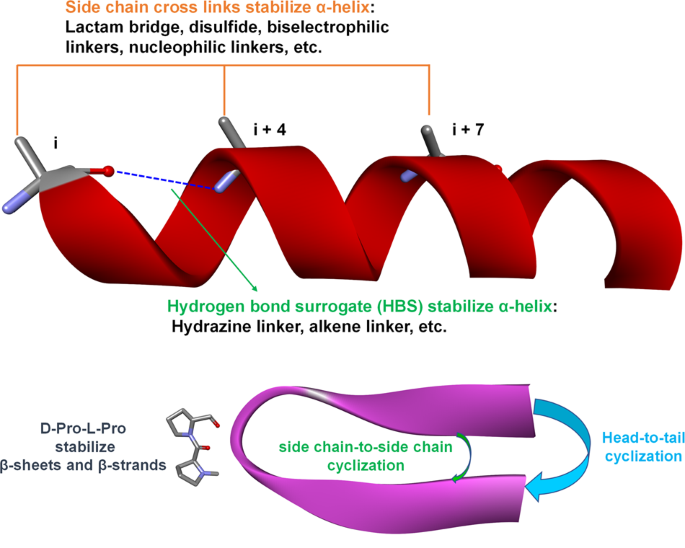
Strategies of peptide cyclization and stabilization of α-helices, β-sheets, and β-strands. The establishment of intramolecular cross-links can stabilize different secondary structures of peptides. Side chain cross-links between i and i + 4 or/and i + 7 and hydrogen bond surrogate cross-links can stabilize α-helices. Side chain-to-side chain, head-to-tail, and side chain-to-tail cyclization can stabilize turn, loop and β structures (β-sheets and β-strands). The D-Pro-L-Pro scaffold can specifically stabilize antiparallel β-hairpins
Stabilizing secondary structures
Peptides may require structural stabilization to reproduce an alpha helix, beta strand, beta sheet, turn, or loop.
Stapled peptides are one example. A chemical cross-link can constrain a peptide toward an alpha-helical conformation. Other approaches use hydrogen-bond surrogates or different cross-linking architectures.
These methods are especially relevant to peptide inhibitors of protein–protein interactions because the goal can be to mimic a structural region of a larger protein.
Modification involves trade-offs
A change that improves stability can sometimes reduce potency or solubility. A modification that increases target affinity may change pharmacokinetics or manufacturing behavior.
Consequently, peptide optimization usually involves iterative testing rather than a single modification step.
Key takeaway
Peptide modification is the bridge between biological discovery and drug-like molecular design. Backbone chemistry, side-chain changes, cyclization, and structural constraints provide researchers with multiple ways to tune stability, affinity, selectivity, and other properties.
Source & Further Reading
This page is an original educational paraphrase based primarily on:
Wang, L. et al. Therapeutic peptides: current applications and future directions. Signal Transduction and Targeted Therapy 7, 48 (2022).
Read the original open-access review
This page does not reproduce the source article. It is provided for educational and informational purposes and is not medical advice.