

Quick Answer
Solid-phase peptide synthesis (SPPS) is a central chemical method for producing synthetic peptides. A typical workflow involves iterative coupling and deprotection, cleavage, purification, and analytical characterization.
Peptide Synthesis
Peptide synthesis is a central part of modern peptide development. Once a candidate sequence has been identified, chemical or biological production can be used to obtain material for structural, analytical, and biological studies.
Solid-phase peptide synthesis
Solid-phase peptide synthesis (SPPS) is one of the most established chemical approaches. The method, associated with Merrifield's pioneering work, builds the peptide step by step while the growing chain remains attached to a solid support.
A simplified cycle involves coupling an amino acid to the growing chain and removing a protecting group to expose the next reactive site. Repeating these cycles produces the desired sequence, which can subsequently be cleaved from the resin and purified.
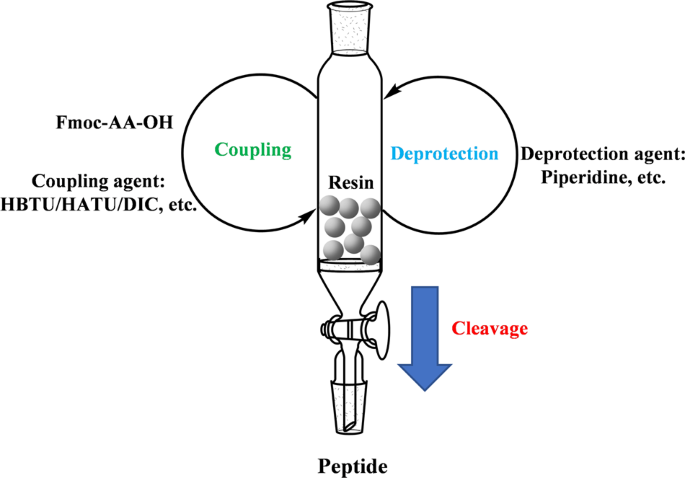
A general process of solid-phase peptide synthesis (SPPS) with Fmoc protected amino acids (Fmoc-AA-OH). Fmoc-SPPS consists a cycle of coupling Fmoc-AA-OH to a solid polymeric resin and deprotection of Fmoc to liberate amino groups. The whole process can be carried out in a sieve reactor till the final peptide is cleaved from the resin
Why SPPS is useful
Compared with recombinant production, chemically synthesized peptides can have a relatively straightforward impurity profile because many impurities arise from incomplete coupling or side reactions during synthesis.
Modern resins and linkers also allow chemists to design synthesis strategies for different peptide termini and for some cyclization approaches.
Fmoc and Boc strategies
Two major protection strategies discussed in the source review are Fmoc-SPPS and Boc-SPPS.
Fmoc refers to fluorenylmethyloxycarbonyl protection, while Boc refers to tert-butyloxycarbonyl protection. They differ in the chemistry used to remove the temporary protecting group and in how the final peptide is released.
Fmoc methods are widely used because deprotection can be performed under comparatively mild conditions. Boc chemistry can offer advantages for some difficult or longer sequences.
Difficult sequences
Peptide synthesis becomes more demanding as sequences become longer or contain challenging combinations of residues. Aggregation can occur during synthesis, reducing coupling efficiency and product purity. Certain sequences can also undergo side reactions such as aspartimide formation.
Researchers have investigated approaches including lower-substitution resins, microwave-assisted synthesis, solvent optimization, and specialized building blocks.
Laboratory synthesis versus manufacturing
Automated synthesizers can rapidly produce multiple sequences at laboratory scale. Large-scale manufacture introduces additional engineering and process-development constraints.
The source review notes that some heating approaches useful at laboratory scale are not always straightforward to translate to large manufacturing equipment because of issues such as heat distribution and by-product formation.
Long peptides remain particularly challenging to manufacture at scale.
Synthesis is only one step
A successful synthesis does not automatically produce a finished pharmaceutical product. The crude material normally requires purification and analytical characterization. Development teams also have to establish appropriate controls for identity, purity, impurities, and consistency.
For commercial manufacturing, process robustness and reproducibility become just as important as laboratory yield.
Key takeaway
SPPS provides a powerful and flexible platform for peptide production, but peptide synthesis is a process-development discipline rather than simply a sequence of reactions. Sequence length, aggregation, side reactions, purification, scale, and analytical control all influence the final outcome.
Source & Further Reading
This page is an original educational paraphrase based primarily on:
Wang, L. et al. Therapeutic peptides: current applications and future directions. Signal Transduction and Targeted Therapy 7, 48 (2022).
Read the original open-access review
This page does not reproduce the source article. It is provided for educational and informational purposes and is not medical advice.