

Quick Answer
Peptide quality control is broader than a single purity percentage. Identity, purity, related substances, residual materials, analytical consistency, and process control all contribute to assessing a peptide material. A “98% pure” peptide can still fail as a drug if the 2% contains a toxic impurity, an incorrect epimer, or a degradation product that compromises stability.
Peptide Purity and Quality Control
Why peptide QC matters
Peptide manufacturing does not end when a target sequence has been synthesized. The resulting material must be characterized to determine whether its identity, purity, and impurity profile are consistent with the intended specification.
For development and manufacturing, analytical control is part of the overall process rather than a separate afterthought. Regulatory agencies require a thorough understanding of physicochemical properties, biological activity, and manufacturing processes before a peptide can be approved for clinical use[citation:3]. The FDA has noted that solid-phase peptide synthesis (SPPS) is highly complex with numerous reaction and purification steps that can collectively have considerable impact on the identity, strength, and purity of the final peptide[citation:6].
A critical reality of peptide manufacturing is that synthesis rarely produces only the desired sequence. Even under optimized conditions, incomplete couplings, side reactions, and degradation during handling create a heterogeneous mixture. Quality control exists to quantify that heterogeneity and ensure it falls within acceptable limits.
Identity and purity are different questions
Identity asks whether the material is the intended peptide. Purity asks how much of the measured material corresponds to the desired component relative to detected related substances and impurities.
A high reported purity value therefore should not be interpreted as a complete description of product quality without considering the analytical method, specification, identity confirmation, and relevant impurities.
Identity confirmation typically requires at least two orthogonal techniques. Mass spectrometry provides molecular weight confirmation and can verify sequence through fragmentation patterns[citation:1]. NMR spectroscopy offers structural information at the atomic level and is particularly valuable for confirming modifications such as fatty acid conjugation or cyclization[citation:2]. Amino acid analysis can distinguish between isobaric residues like leucine and isoleucine that mass spectrometry alone cannot resolve[citation:2].
The distinction matters practically. A peptide might show 99% purity by HPLC-UV but contain a significant proportion of D-amino acid epimers that co-elute with the main peak. Only chiral analysis would reveal this problem[citation:10]. Similarly, a peptide with the correct mass might have an incorrect disulfide connectivity, which requires specialized methods to detect.
Sources of peptide-related impurities
Impurities can arise during synthesis, cleavage, deprotection, handling, purification, storage, or formulation. Incomplete coupling, side reactions, degradation, and aggregation are among the types of issues that can affect peptide material.
The appropriate control strategy depends on the sequence, synthesis route, scale, formulation, and intended use.
Process-related impurities originate from the manufacturing process itself. These include:
- Deletion peptides: sequences missing one or more amino acids due to incomplete coupling
- Truncated peptides: shorter fragments resulting from premature chain termination
- Epimers: peptides containing D-amino acids instead of the intended L-form, formed through racemization during coupling or deprotection
- β-isomer peptides: rearrangement products, particularly common with aspartic acid residues
Degradation products form during storage or handling:
- Hydrolysis products: peptides cleaved at labile sites, often near aspartic acid or proline residues
- Oxidation products: modification of methionine, cysteine, tryptophan, or tyrosine residues
- Deamidation products: conversion of asparagine or glutamine to aspartic or glutamic acid
- Acetylation products: N-terminal modification, sometimes intentional, sometimes not
- Aggregates: non-covalent or covalent oligomers that can form under stress conditions
A study of the antimicrobial peptide Cbf-14 identified one process-related impurity and thirty-two degradation products, including fifteen hydrolysates, five isomers, four acetyl-isomers, two aldimine derivatives, and six oxidized impurities[citation:4]. This example illustrates the complexity of the impurity landscape even for a relatively short peptide.
Residual materials from synthesis and purification include:
- Trifluoroacetic acid (TFA) from cleavage and HPLC purification
- Acetic acid from counter-ion exchange
- Residual solvents from synthesis and purification steps
- Water content, which affects net peptide content calculations
For peptides containing basic amino acids (Arg, Lys, His), TFA or acetate is firmly bound as a counter-ion. This means the “net peptide content” (NPC) — the percentage of actual peptide relative to non-peptidic material — can be significantly lower than the purity value[citation:8]. A peptide with 95% purity might have only 70% NPC due to counter-ion and moisture content. Both numbers matter when preparing solutions for biological assays or formulating a drug product.
Analytical methods for peptide characterization
Identity confirmation methods
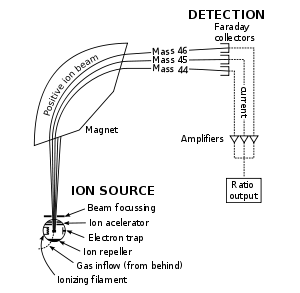
Fig. 1 Schematic of a typical mass spectrometer. Mass spectrometry is the cornerstone of peptide identity confirmation, providing molecular weight and sequence information. Image source: Wikimedia Commons (Public Domain, USGS).
Mass spectrometry (MS) is the cornerstone of peptide identity testing. Electrospray ionization (ESI) coupled with LC-MS/MS allows accurate molecular weight determination and sequence verification through fragmentation patterns[citation:1][citation:2]. High-resolution instruments like Q-TOF or Orbitrap provide mass accuracy sufficient to distinguish closely related sequences.
NMR spectroscopy provides structural information complementary to MS. Proton, carbon, COSY, NOESY, TOCSY, and HSQC experiments can confirm the identity of individual amino acids and detect unexpected modifications[citation:2]. While more time-consuming than MS, NMR is particularly valuable for reference standard characterization.
Amino acid analysis (AAA) involves hydrolyzing the peptide into constituent amino acids and quantifying them by chromatography. This method can distinguish between residues with identical mass (Leu/Ile) that MS cannot resolve[citation:2]. However, it destroys sequence information.
Peptide mapping using enzymatic digestion followed by LC-MS/MS confirms the primary structure and can localize modifications. This approach is especially useful for larger peptides and for verifying disulfide connectivity[citation:18].
Purity assessment methods

Fig. 2 Preparative HPLC system, the standard platform for peptide purification and purity assessment by reversed-phase chromatography. Image source: Wikimedia Commons (CC BY 3.0).
Reversed-phase HPLC (RP-HPLC) with UV detection at 210–220 nm is the standard method for peptide purity assessment[citation:2][citation:8]. The amide backbone absorbs strongly in this region, providing sensitive detection of both the main peak and related substances. Purity is typically calculated as the area percentage of the main peak relative to total peak area.
The limitations of this method deserve attention. Co-eluting impurities are invisible to UV detection. Different impurities may have different extinction coefficients. And a single wavelength cannot distinguish between peptide-related and non-peptide peaks.
UHPLC with high-resolution mass spectrometry (UHPLC-HRMS) addresses many of these limitations. By combining chromatographic separation with accurate mass detection, it can identify and quantify impurities that co-elute with the main peak[citation:1][citation:11]. The FDA recommends UHPLC-HRMS for detecting and characterizing peptide-related impurities in generic synthetic peptides[citation:1].
Chiral chromatography is essential for detecting D-amino acid epimers. A method using chiral HPLC coupled with ESI-MS/MS has been validated for all nineteen chiral proteogenic amino acids and applied to peptides containing 8–14 residues[citation:10]. The method involves hydrolysis in deuterated acid to correct for racemization during sample preparation, followed by direct chiral separation without derivatization[citation:15].
Additional quality attributes
Beyond identity and purity, peptide materials require assessment of:
Water content by Karl Fischer titration, which affects net peptide content and stability[citation:8].
Residual solvents by gas chromatography, particularly for peptides purified using organic solvents[citation:8].
Counter-ion content by ion chromatography or titration. Acetate and TFA content directly impacts NPC and can affect biological activity if the counter-ion interacts with the active site[citation:8].
Elemental analysis for nitrogen content, which provides an independent measure of peptide content[citation:8].
Physical properties including appearance, solubility, and hygroscopicity, which affect handling and formulation.
QC across the manufacturing workflow
Analytical characterization is connected to synthesis and purification. Process teams can use analytical results to understand reaction performance, identify difficult sequences, evaluate purification, and monitor consistency between batches.
For pharmaceutical development, the required analytical package is determined by the development stage, product characteristics, applicable specifications, and regulatory expectations.
In-process controls during SPPS include tests for free amine groups after each coupling step. The Kaiser test (ninhydrin), TNBS test, and chloranil test for secondary amines are colorimetric methods that detect incomplete coupling[citation:19]. These rapid tests allow synthesis to proceed only when coupling efficiency is acceptable.
Intermediate characterization becomes critical for hybrid SPPS/LPPS manufacturing strategies. Tirzepatide, for example, is manufactured using four shorter peptide fragments (each ≤14 residues) that are synthesized separately, purified to high purity, characterized as precipitated intermediates, then coupled in liquid phase[citation:11]. Each fragment requires its own analytical method for impurity quantitation.
Final drug substance release testing typically includes:
- Appearance and solubility
- Identity by MS and/or amino acid analysis
- Purity by RP-HPLC and possibly UHPLC-HRMS
- Counter-ion content
- Water content
- Residual solvents
- Elemental analysis (nitrogen)
- Specific tests for known impurities or degradation products
Stability testing monitors degradation over time under defined conditions. Peptides with oxidizable residues require special attention to headspace oxygen content in lyophilized vials[citation:2]. Methionine, cysteine, tryptophan, and tyrosine are particularly susceptible to oxidation. Hydrolysis, deamidation, and aggregation are other common degradation pathways.
Regulatory considerations
Peptide drugs occupy a regulatory space between small molecules and biologics. The FDA classifies peptides as alpha amino acid polymers with 40 or fewer amino acids, regulated under the Federal Food, Drug, and Cosmetic Act unless they meet the definition of a biological product[citation:19]. This classification has significant implications for the approval pathway.
The regulatory framework for synthetic peptides continues to evolve. The FDA withdrew its 2021 guidance on ANDAs for certain highly purified synthetic peptide drug products in 2026, indicating that the agency is revising its approach to generic peptide assessment. The EMA published its guideline on development and manufacture of synthetic peptides in 2023[citation:19]. China’s CDE released its own technical guidance for chemically synthesized peptide drugs in 2023, covering manufacturing processes, structural confirmation, quality research, and stability studies[citation:14].
Despite these efforts, harmonization remains incomplete. A review comparing European Pharmacopoeia and United States Pharmacopeia peptide monographs found significant differences in identification, purity, and assay specifications, increasing the burden on manufacturers who must comply with different standards in different markets[citation:16].
The ICH Q6A guideline states that identification should be performed by at least two orthogonal techniques[citation:1]. For peptides, this typically means combining a chromatographic method (retention time) with a spectrometric method (mass or NMR). Relying on a single retention time is insufficiently specific, as different peptides can co-elute under many conditions.
A practical QC mindset
When evaluating a peptide material, useful questions include:
- What is the stated specification, and does the certificate of analysis address identity, purity, and impurity profile?
- How was identity confirmed? Was it by a single method or orthogonal techniques?
- What analytical method was used to report purity? RP-HPLC alone, or with MS confirmation?
- What related substances or degradation products were evaluated? Were they identified and quantified?
- Is the “net peptide content” (NPC) reported, or only the chromatographic purity?
- Are batch-specific analytical records available, or only a generic specification sheet?
- Are storage and handling conditions defined, including temperature, humidity, and light protection?
- Has stability data been generated under relevant conditions?
These questions distinguish between a supplier who simply runs an HPLC and one who has a comprehensive understanding of the material.
Key takeaway
Peptide purity is an important QC parameter, but it is only one part of peptide characterization. Reliable peptide quality assessment connects identity, purity, impurities, analytical methods, process controls, and batch consistency. A number on a certificate of analysis means little without understanding how it was generated and what it does not capture.
The complexity of peptide quality control reflects the complexity of peptide synthesis itself. Each step — coupling, deprotection, cleavage, purification, lyophilization — can introduce or remove impurities. Each analytical method reveals some aspects of the material while remaining blind to others. Effective quality control requires a coordinated strategy that combines orthogonal methods, appropriate specifications, and process understanding.
Source & Further Reading
This page is an original educational overview drawing on publicly available regulatory guidance and analytical literature. It is not a reproduction of any single source.
Key references for further reading:
- FDA Science Forum: Quality Considerations in Solid Phase Peptide Synthesis (2021)
- USP: Reference Standards to Support Quality of Synthetic Peptide Therapeutics (2023)
- Regulatory Considerations in Synthetic Peptide Characterization (2025)
- China CDE: 化学合成多肽药物药学研究技术指导原则 (2023)
This page is provided for educational and informational purposes and is not medical advice.