

Quick Answer
Peptide delivery is strongly influenced by enzymatic stability, membrane permeability, molecular size, target location, formulation, and route of administration. Delivery research therefore often runs in parallel with peptide optimization. The central challenge is to keep enough intact peptide at the right place for long enough to produce a therapeutic effect.
Peptide Delivery
Why delivery matters
Peptides can be vulnerable to enzymatic degradation and may have limited ability to cross biological membranes. These properties can make oral and intracellular delivery difficult.
As a result, peptide development often includes delivery research alongside molecular design. The objective is to achieve sufficient exposure to the intended target while maintaining molecular stability and acceptable pharmacokinetics.
Unlike small molecules, peptides cannot usually rely on passive diffusion and broad tissue distribution. Their size, polarity, and hydrogen-bonding pattern work against them, and the body has evolved many proteases specifically to break peptide bonds. Delivery is therefore not a packaging step added at the end—it is a constraint that shapes which molecules are worth developing at all.
Main factors that influence peptide delivery
Delivery performance can depend on:
- Peptide size and length — larger peptides diffuse more slowly and are generally less permeable.
- Amino-acid composition — charge and hydrophobicity affect membrane interaction and aggregation.
- Structural stability — secondary structure can protect against proteases but may also affect absorption.
- Target location — extracellular receptors are far easier to reach than intracellular targets.
- Formulation — excipients, pH, and concentration affect stability and uptake.
- Route of administration — injection, oral, pulmonary, and transdermal routes impose very different barriers.
- Susceptibility to enzymatic degradation — the dominant clearance mechanism for most peptides.
A delivery strategy therefore cannot be selected independently of the molecule. A peptide intended for an extracellular receptor may present very different requirements from one intended to reach an intracellular target.
Routes of administration
Subcutaneous and intravenous injection remain the default for most approved peptide drugs. They bypass the gastrointestinal barrier and give reliable exposure, but they are inconvenient for chronic treatment and depend on patient compliance.
Oral delivery is the most attractive route for chronic diseases, but it is also the most difficult. The stomach's acidic environment and the abundance of digestive proteases can destroy a peptide before it reaches the bloodstream. Only a small number of peptides have achieved meaningful oral bioavailability.
Pulmonary delivery offers a large surface area and relatively thin epithelium, and has been explored for insulin and other peptides. Variability in dosing and local tolerability remain concerns.
Transdermal and implantable delivery are being investigated for selected peptides, particularly where long-term, steady exposure is desirable. Implantable pumps and microchips can provide programmable release, though they require a procedure to place and maintain.
Approaches discussed in peptide-delivery research
Research has explored structural modification, cyclization, carrier systems, nanoparticles, and cell-penetrating strategies to improve stability, absorption, tissue penetration, or targeting.
Cell-penetrating peptides (CPPs) are particularly relevant when researchers need to move peptide cargo across cellular or tissue barriers. CPPs are typically short, cationic, or amphipathic sequences that can promote uptake through mechanisms including endocytosis and direct membrane translocation. A well-known example is the Tat peptide derived from HIV, which has been used to deliver proteins and peptides across the blood–brain barrier.
Nanoparticles and carrier systems can protect peptides from degradation, improve solubility, and provide sustained release. Liposomes, polymeric nanoparticles, and lipid-based carriers have all been explored. The source review also discusses peptide-based delivery concepts involving the blood–brain barrier, antigen delivery, and nanocluster approaches.
Targeting moieties such as RGD peptides, NGR motifs, and tumor-penetrating peptides can direct a peptide or its carrier to a specific tissue. This is especially relevant in oncology, where selectivity determines the therapeutic window.
Delivery and molecular optimization are connected
Chemical modification can change both biological activity and delivery-related properties. Improving protease resistance, for example, may extend exposure, while changing charge or hydrophobicity can affect membrane interaction and formulation behavior.
Consequently, peptide delivery is best understood as part of an integrated development process rather than as a final-stage packaging problem.
This interconnection means that discovery, modification, and delivery teams increasingly work together. A modification that improves binding affinity may worsen solubility, and a formulation that improves absorption may alter the peptide's conformation and reduce potency. Trade-offs are unavoidable, and they are best managed early.
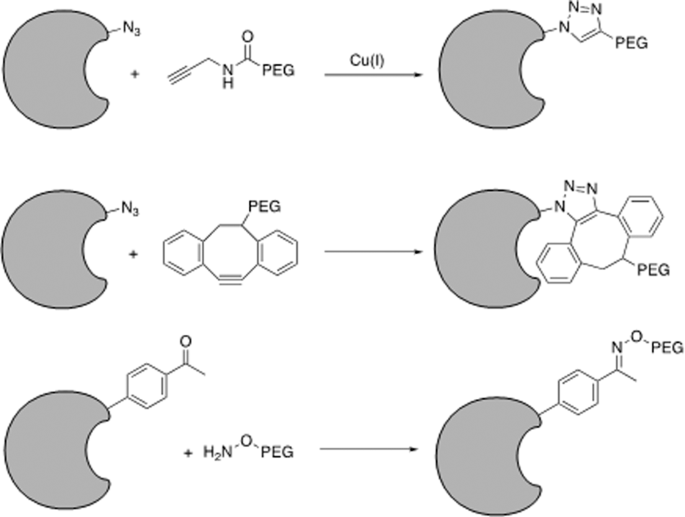
Fig. 1 PEGylation of therapeutic peptides and proteins via genetic code expansion. Azide or acetyl groups are introduced into therapeutic peptides and proteins to allow downstream PEGylation modifications, which can extend half-life and improve delivery-related pharmacokinetics. Source: Wang et al., Signal Transduction and Targeted Therapy (2022) 7:48. Licensed under CC BY 4.0.
Formulation strategies for oral delivery
Co-formulation with permeation enhancers is a promising strategy to enable the oral administration of peptide drugs.
Semaglutide conjugated with C18 fatty acid was approved for administration by once-weekly subcutaneous injection, with greater plasma stability than other GLP-1 analogues. Even more encouragingly, the co-formulation of semaglutide with sodium N-[8-(2-hydroxybenzoyl amino]caprylate (SNAC) was approved for oral administration to treat T2DM.
Co-formulation with SNAC prevents the destruction of semaglutide in the stomach by decreasing the efficacy of digestive enzymes. The hydrophobic SNAC molecules also increase the lipophilicity of semaglutide, thus improving its transcellular absorption through the gastric membrane and its transport into the systemic circulation.
Co-formulation with other permeation enhancers, enzyme inhibitors, and hydrogels have also been used to allow the oral administration of other peptide drugs, such as octreotide and insulin, which are now in clinical trials. Enzyme inhibitors can reduce proteolytic breakdown in the gut, while hydrogels can protect the peptide and control its release.
More strategies, including pulmonary administration, transdermal delivery, and the use of implantable pumps, are currently under investigation for the delivery of specific peptide drugs, including the development of inhalable insulin and micro-implantable pumps for insulin delivery. We expect these technologies to be applied for more peptide drugs in the coming years.
Challenges that remain
Despite progress, several barriers persist. Oral bioavailability for most peptides remains very low, often below 1–2%. Long-term safety of permeation enhancers and carriers is still being evaluated. Manufacturing at scale for modified peptides and nanoparticle formulations can be complex and costly. And for intracellular targets, delivery remains largely unsolved outside of specialized CPP approaches.
These challenges explain why most approved peptide drugs are still administered by injection, and why delivery research is an active area of both academic and industrial effort.
Key takeaway
Peptide delivery is shaped by the relationship between molecular structure, stability, biological barriers, formulation, and target location. Effective development commonly requires simultaneous optimization of the peptide molecule and its delivery strategy. Progress in formulation science, carrier design, and molecular engineering is steadily expanding what is possible, but delivery remains one of the central bottlenecks in peptide therapeutics.
Source & Further Reading
This page is an original educational paraphrase based primarily on:
Wang, L. et al. Therapeutic peptides: current applications and future directions. Signal Transduction and Targeted Therapy 7, 48 (2022).
Read the original open-access review
This page does not reproduce the source article. It is provided for educational and informational purposes and is not medical advice.