

Quick Answer
Therapeutic peptides have been applied or investigated across metabolic and endocrine disease, cardiovascular disease, oncology, pain and neurological conditions, infectious disease, vaccines, and targeted delivery research.
Applications of Therapeutic Peptides
Therapeutic peptides in the treatment of diabetes mellitus
T2DM is caused by an acquired insulin deficiency and is common in middle-aged and older people. T2DM has been successfully treated with peptide drugs, including GLP-1 receptor agonists (GLP-1RAs) and the best-known peptide drug, insulin. GLP-1 is an endogenous growth hormone secreted by L-cells in the ileum. Its receptors are present in pancreatic β-cells, the peripheral and central nervous systems, heart and blood vessels, kidneys, lungs, and gastrointestinal mucosa . GLP-1 interacts with its receptor to stimulate islet β-cells to secrete insulin, inhibit the release of glucagon by islet α-cells, increase satiety, and delay gastric emptying in a glucose-dependent manner. Endogenous GLP-1 is degraded by dipeptidyl peptidase-4 (DPP-4) and is rapidly inactivated. In order to prolong the stimulation time of GLP-1 receptors, synthetic GLP-1RAs are required to prevent its degradation. Since the first GLP-1RA, exenatide, was approved by the US Food and Drug Administration (FDA) in 2005, several GLP-1RAs have entered the clinic, including liraglutide (2009), lixisenatide (2013), dulaglutide (2014), and semaglutide (2017). After injection, these GLP-1RAs effectively reduce glycosylated hemoglobin and average blood glucose levels and improve fasting blood glucose.
!Mechanisms of GLP-1 and GLP-1RA peptide drugs in regulation of T2DM](https://media.springernature.com/lw685/springer-static/image/art%3A10.1038%2Fs41392-022-00904-4/MediaObjects/41392_2022_904_Fig11_HTML.png)
Mechanisms of GLP-1 and GLP-1RA peptide drugs in regulation of T2DM. GLP-1 and GLP-1RA peptide drugs treat T2DM by regulating multiple organs functions, such as reducing gastric emptying and gastric acid secretion, reducing appetite, promoting cardiac glucose utilization, accelerating renal natriuresis and diuresis, minimizing glucose production in the liver and increasing insulin secretion in the pancreas
Some GLP-1RAs are also effective or the treatment of some complications of T2DM. Diabetic nephropathy is one of the most dangerous complications of T2DM, leading to severe effects on kidney function in diabetic patients, with clinical manifestations including proteinuria and decreased glomerular filtration rate (GFR). In a study of 35 patients with T2DM, lixisenatide reduced the absolute and partial excretion of magnesium, calcium, and phosphate by inhibiting the proximal tubule sodium-hydrogen antiporter 3 (NHE3) and thus increasing the absolute and partial excretion of sodium, chlorine, and potassium and increasing urine pH values compared with insulin glargine. In addition, in a study of 30 T2DM patients, liraglutide significantly reduced GFR, urinary albumin excretion rate, and partial albumin excretion. GLP-1RAs can reduce GFR by increasing sodium efflux to the macula densa, increasing tubulo-glomerular feedback and vasoconstriction of afferent arterioles, and may also reduce albuminuria by reducing plasma renin activity, reducing renal oxidative stress, and increasing natriuresis. However, the extent to which these effects are mediated by GLP-1R remains to be determined. Recent studies have confirmed that the metabolites of GLP-1 retain important antioxidant and anti-apoptotic activities, which are independent of GLP-1R. Cardiovascular disease remains the leading cause of death in patients with T2DM, and the prevention and treatment of cardiovascular complications should thus be considered when choosing treatments for T2DM. GLP-1RAs have been shown to play a beneficial role in cardiovascular disease. Recent clinical trials found that only liraglutide and semaglutide had advantages in terms of cardiovascular benefits, although the mechanism is still unclear and may be anti-atherosclerotic. The protective effects of other GLP-1RAs on cardiovascular disease are not obvious, but they have no harmful effects on other safety parameters, and the risk-benefit distribution of GLP-1RAs is thus well-balanced. GLP-1RAs also showed therapeutic effects on obesity symptoms in patients with T2DM. Thondam reported that a patient with severe hypothalamic obesity and various obesity-related complications, including T2DM, responded well to exenatide, with significantly improvements in weight and blood glucose control, possibly through a central regulatory mechanism increasing satiety and reducing energy intake. A study of 25 obese patients with T2DM showed that patients treated with metformin and sulfonylurea/DPP-4 inhibitors for 6 months who took GLP-1RA (exenatide19, six cases) had significantly reduced average body weight, glycosylated hemoglobin, and intrahepatic lipids. Body mass index and fat thickness also decreased significantly in 25 patients with T2DM treated with exenatide and liraglutide for 3 months. T2DM can lead to bone brittleness and increase the risk of bone-related complications such as fractures and poor fracture healing. Experimental studies found that GLP-1RAs had a significant positive effect on bone quality and strength, possibly by improving the blood supply to the bone necessary for bone health. In one study, liraglutide was applied to ovariectomized rats with T2DM, followed by high-throughput sequencing of bone marrow-derived exosome micro RNAs (miRNAs). Liraglutide was shown to cause significant changes in exosome miRNAs targeting the insulin signaling pathway, and changes in the Wnt/β-catenin signaling pathway mediated by bone marrow exosomes were implicated in the osteoprotective effect.
The most common side effects of GLP-1RA treatment are gastrointestinal-related adverse reactions (i.e., nausea, vomiting, and diarrhea) and injection-site reactions, while long-acting GLP-1RAs have fewer side effects, a lower administration frequency. and better compliance. Metformin is still the first-line drug for the treatment of T2DM in the clinic. According to the European Diabetes Research Association and the American Diabetes Association, GLP-1RAs, sulfonylureas, thiazolidinediones, DPP-4 inhibitors, sodium-glucose cotransporter 2 inhibitors, and insulin are recommended as complementary drugs for patients whose blood sugar is not sufficiently controlled by metformin alone. However, based on the many other benefits of GLP-1RAs in addition to blood glucose control, including renal protection, reduced risk of cardiovascular disease, weight control, no risk of hypoglycemia, benefits for skeletal symptoms, and low-frequency side effects, GLP-1RAs will play an essential role in the treatment of T2DM in the future.
Therapeutic peptides in the treatment of cardiovascular disease
Among non-communicable diseases, cardiovascular disease is now the leading cause of death and morbidity worldwide. Hypertension is one of the main risk factors for the development of cardiovascular disease, and is considered to be caused by high activity of the renin-angiotensin-aldosterone system (RAAS) and sympathetic nervous system,as well as sodium retention. The function of angiotensin-converting enzyme (ACE) in the RAAS is to cleave angiotensin I into angiotensin II, to contract blood vessels and indirectly increase blood pressure, while ACE2 hydrolyzes angiotensin II into vasodilator angiotensin (1-7) to indirectly reduce blood pressure. Targeting the RAAS thus represents an ideal strategy for controlling cardiovascular diseases. Synthetic angiotensin II was approved by the FDA in 2017 for increasing blood pressure via intravenous infusion in adults with septicemia or other distributed shock. Four peptides (WPRGYFL, GPDRPKFLGPF, WYGPDRPKFL, and SDWDRF) isolated and screened from _Tetradesmus obliquus_ microalgae by Montone et al. showed inhibitory activity against ACE. Liao et al. found that the tripeptide IRW, derived from egg white, reduced blood pressure in spontaneously hypertensive rats by up-regulating the expression of ACE2. These studies indicate the potential application of food-derived peptides targeting RAAS for the treatment of cardiovascular diseases.
Natriuretic peptide (NPs), including atrial natriuretic peptide (ANP), brain natriuretic peptide (BNP), and C-type natriuretic peptide (CNP), are essential regulators of cardiac and vascular homeostasis. Targeting NPs is thus another practical strategy for the prevention or treatment of cardiovascular diseases. Nesiritide is a recombinant human BNP that was approved by the FDA in 2001 for the treatment of acutely decompensated heart failure in patients with resting or mild dyspnea; however, it has not been widely used due to its low specificity and limited safety. NPs act mainly through NPR-A and/or NPR-B receptors, while NPR-C is mainly used for scavenging NPs. Cenderitide is a dual NPR-A/NPR-B agonist composed of CNP and the C-terminal of dendroaspis natriuretic peptide isolated from the green mamba snake. Cenderitide is currently in clinical research and has shown safety and potential for the treatment of heart failure and renal failure. In addition, some peptides that are beneficial to cardiovascular disease are being tested in animals. For example, infusion of vasoactive intestinal peptide increased the concentration of myocardial vasoactive intestinal peptide and reversed existing myocardial fibrosis in rats, and cyclopeptide RD808 neutralized the β1\-adrenergic receptor, thus attenuating myocardial injury induced by the β1\-adrenergic receptor in mice. The central adrenocorticotropin-releasing factor (CRF)-related peptide system is currently attracting increasing attention as a target for the prevention of cardiovascular disease. There is a complex relationship between the CRF-related peptide system and the cardiovascular system, but its exact regulatory role in cardiovascular function remains to be determined. In addition, the activity of circulating DPP-4 was increased and flow-mediated dilation was decreased in patients with T2DM. Flow-mediated dilation is a recognized alternative marker of endothelial dysfunction and a predictor of future cardiovascular events, suggesting that DPP-4 may be a potential target for preventing cardiovascular disease.
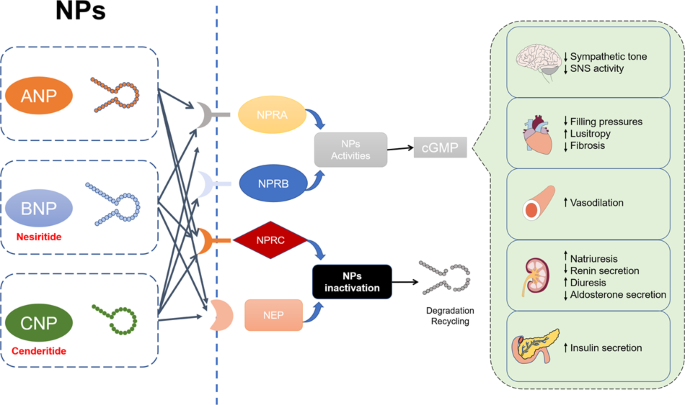
Mechanism of natriuretic peptide (NPs) regulation. Atrial natriuretic peptide (ANP), brain natriuretic peptide (BNP), and C-type natriuretic peptide (CNP) regulate cardiac and vascular homeostasis through binding to their receptors (NPR-A, -B and -C) to reduce sympathetic tone, fibrosis and renin secretion to treat cardiovascular diseases
Therapeutic peptides in the treatment of gastrointestinal diseases
Therapeutic peptides in the treatment of intestinal disease
In the human body, gastrointestinal flora constitutes a complex micro-ecosystem. Typically, the gastrointestinal flora in the human body constitutes a complex micro-ecosystem. Typically, the epithelium regulates the composition of the intestinal flora at the intestinal mucosal interface by providing a physical barrier and secreting various antimicrobial factors, including antimicrobial peptides (AMPs). The dominant flora (physiological flora) and weak flora (pathogenic bacteria) maintain a dynamic balance, which is disrupted in various intestinal diseases caused by exotic bacteria, viruses, and parasites, food poisoning, adverse drug reactions, and genetic factors, such as enteritis, constipation, intestinal ulcers, and inflammatory bowel disease (IBD). The extensive use of antibiotics may further reduce the biodiversity of symbiotic bacteria, which is not conducive to treatment and may even aggravate the disease; for example, individuals affected by IBD are more likely to have used antibiotics within 2-5 years before diagnosis. Peptide drugs have attracted much attention in this field because of their specificity, efficacy, and low toxicity.
Significant changes in the normal intestinal flora and the destruction of host-microbial symbiosis may be the key to the development of IBD. IBD, including Crohn’s disease and ulcerative colitis, is caused by an intestinal immune response, and the associated inflammation is caused by the interaction between environmental and genetic factors. However, the specific pathogenesis of IBD is still unclear and there is currently no effective cure. Intestinal microbial diversity is significantly reduced in patients with IBD, and the two dominant phyla Firmicutes (Lachnospiraceae) and Bacteroidetes, were significantly decreased while the phylum Proteus was significantly increased. Substantial evidence has indicated a key role for members of the phylum Proteus in IBD. Proline-arginine-39, a small cationic AMP that is naturally secreted by porcine bone marrow and lymphoid tissue, has demonstrated antibacterial, immunomodulatory, and intestinal epithelial repair functions and may provide a safe alternative therapy for IBD.
Patients with Crohn’s disease are often treated by bowel resection, leading to short bowel syndrome (SBS). Damage to the small intestine and abnormal shortness of the small intestine at birth may also cause SBS, which is defined as symptoms associated with a persistent length of the residual small intestine of <200 cm. GLP-2 is produced by intestinal endocrine L cells and various neurons in the central nervous system and has recently received extensive attention for the treatment of SBS. GLP-2 has demonstrated various beneficial effects, including stimulating crypt cell growth, reducing intestinal cell apoptosis, promoting intestinal mucosal dilatation, inhibiting gastric acid secretion and gastric emptying, stimulating intestinal blood flow, strengthening intestinal barrier function, reducing anti-inflammatory injury, and promoting nutrition and liquid absorption. GLP-2 also regulated the expression of amino acid transporters and directly activated mTORC1 to increase the absorption of amino acids in the intestinal epithelium. Some specific amino acids (including glutamine, glutamate, arginine, glycine, lysine, methionine, and sulfur-containing amino acids) have also been shown to play an important role in maintaining intestinal integrity, including preventing intestinal atrophy, improving intestinal barrier function, and reducing inflammation and apoptosis. Endogenous GLP-2 is easily degraded by DPP-4; however, the GLP-2 analogue teduglutide prolongs the half-life from 7 minutes to about 2-3 hours by substitution of alanine by glycine in the second position of the N-terminal of GLP-2, effectively preventing its degradation by DPP-4. Clinical studies have shown that teduglutide can effectively reduce or eliminate the need for parenteral nutrition and/or intravenous infusion support, while the application of teduglutide in young pigs with distal ileectomy significantly increased the weight per unit weight and protein synthesis of the remnant intestine. Teduglutide was approved by the FDA for clinical use in SBS patients in 2012. Wiśniewski et al. designed a series of GLP-2 analogues, including 2-glycine substitution, 10-norleucine substitution, 11- and/or 16-hydrophobic substitution, many of which were more effective against GLP-2R than natural hormones, showing good receptor selectivity and low systematic clearance. Among these, the peptide (\[2Gly, 10Nle, 11DPhe, 16Leu\] hGLP-2-(1−33)-NH2) was selected as a candidate for clinical development. GLP-1 from the proglucagon family has similar functions to GLP-2 and has been suggested for the treatment of SBS. In one study, five patients with SBS showed improved stool frequency and morphology after treatment with the GLP-1 agonist exenatide. Similarly, GLP-1 reduced diarrhea in nine SBS patients, but was less effective than GLP-2, while the combination of GLP-1 and GLP-2 was superior to administration of either alone. Glicentin, another member of the proglucagon family, also appears to be involved in many processes such as enteral nutrition, exercise, and gastric acid secretion, indicating the prospect of developing glicentin-like peptides. Other growth factors such as EGF, erythropoietin, and hepatocyte growth factor have also shown therapeutic potential in SBS. The combination of EGF and GLP-2 increased the length of the small intestine in three newborn piglet models of SBS, indicating that EGF has therapeutic potential in neonatal SBS. Erythropoietin protected intestinal barrier function and protected the gastrointestinal tract from ischemia/reperfusion injury by stimulating the expression of tight junction proteins in animal models, and enteral injection of hepatocyte growth factor reduced the incidence and severity of necrotizing enterocolitis in rats.
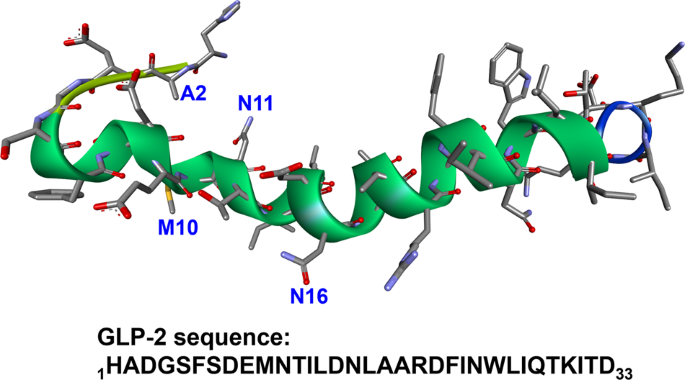
The structure and sequence of GLP-2 (PDB: 2L63) _Clostridium difficile_ toxin A produced by pathogenic strains of _Clostridium difficile_ causes diarrhea and inflammation and even severe pseudomembranous colitis in infected people. Periplanetasin-2 (YPCKLNLKLGKVPFH) is an AMP isolated from the American cockroach by Ji et al., which blocks the mucosal damage and inflammation induced by _Clostridium difficile_ toxin A, and was recently identified as a candidate drug for relieving/treating pseudomembranous colitis caused by _Clostridium difficile_ toxin A. The 9-mer disulfide dimer peptide CopA3 (LLCIALRKK) isolated from the Korean dung beetle significantly improved the small intestinal inflammatory response (acute enteritis) induced by _Clostridium difficile_ toxin A and completely blocked the inflammatory response and subsequent fatal response of chronic colitis induced by sodium dextran sulfate in mice. Food poisoning caused by _Clostridium perfringens_ type A is related to several important human gastrointestinal diseases, and is thought to be mediated by the production of _Clostridium perfringens_ enterotoxin (CPE) combined with human intestinal claudins. Archana et al. found that preincubation or co-incubation of CPE with the claudin-4 extracellular loop ECL-2 peptide significantly inhibited CPE-induced luminal fluid accumulation and histological lesions in rabbit intestinal loop, suggesting that the synthetic peptide ECL-2 may represent a potential strategy for preventing intestinal histological damage caused by _Clostridium perfringens_ type A. Cathelicidin secreted by human colonic epithelium is another AMP with a wide range of antimicrobial and immunomodulatory functions. Recent studies have shown that human cathelicidin helped early colonic epithelial cells defend against enterogenous _Salmonella typhimurium_ by preventing bacterial invasion and maintaining the integrity of the epithelial barrier, possibly by producing Toll-like receptor-4 and pro-inflammatory cytokines. In addition, enterovirus infection has also been shown to stimulate the expression of AMPs. Chen et al. found that small ribonucleic acid virus infection increased the expression and secretion of human β defensin-3 in intestinal epithelial cells, and human β defensin-3 had extracellular anti-enterovirus activity.
Patients with cystic fibrosis (CF) usually also have intestinal obstruction and constipation, which may develop into distal intestinal obstruction syndrome. The guanylate cyclase C (GCC) receptor agonist, linaclotide, was approved by the FDA in 2012 for the treatment of chronic constipation. Linaclotide has also been shown to improve intestinal transport in CF model mice, although further studies are required to evaluate its effects on the intestinal pathology in CF patients. The NHE3 inhibitor tenapanor improved gastrointestinal transport in CF mice by targeting inhibition of sodium absorption, indicating that inhibition of GCC signal transduction and NHE3 may be a suitable target for the treatment of constipation in patients with CF.
In addition to drug-derived peptides, peptides may also be food-derived. Asn-Pro-Trp-Asp-Gln (NPWDQ), a peptide obtained by hydrolyzing casein (a major milk protein), significantly inhibited the penetration of the food allergen, ovalbumin, into human intestinal Caco-2 cells, suggesting that this peptide might improve the function of the intestinal epithelial barrier. β-Casofensin is a peptide found in fermented milk, and in vivo experiments found that early administration of β-casofensin reduced indomethacin-induced intestinal injury and inflammation by protecting goblet cells and promoting wound healing. Indomethacin-induced intestinal damage has the same clinical, histological, and pathophysiological characteristics as Crohn’s disease, suggesting that β-casofensin may be a potential adjuvant therapy for Crohn’s disease.
Peptide drugs also have broad prospects in the treatment of intestinal diseases in livestock. Liu et al. developed a modified synthetic peptide KR-32 using natural snake AMP as the raw material. KR-32 improved the malabsorption of fatty acids, total digestibility of ether extract, and intestinal morphology in piglets treated with enterotoxigenic _Escherichia coli_ K88, indicating the potential medicinal value of KR-32. C-BF is a peptide derived from cathelicidins, as the most prominent AMP family, and is considered to be the most promising substitute for antibiotics. C-BF significantly improved the growth of weaned piglets and improved the structural and developmental damage to the small intestine caused by LPS, indicating that C-BF may be a potential treatment for intestinal damage caused by LPS/pathogens.
Therapeutic peptides in the treatment of gastric disease
The gastric mucosa is one of the most vulnerable tissues in humans and animals, and gastric diseases are a common problem. _Helicobacter pylori_ infection, non-steroidal anti-inflammatory drugs, alcohol, smoking, mood, and stress are the main factors responsible for stomach damage, which in turn leads to gastritis and ulcers. Stomach disease can develop into a chronic disease in the absence of timely treatment or with improper treatment, and sustained long-term damage greatly increases the risk of gastric cancer. Gastric cancer is currently the fourth most frequently diagnosed cancer worldwide, and the third and fifth leading causes of cancer-related deaths among men and women, respectively.
Although no peptides have yet been approved for the treatment of gastric diseases, the roles of peptides in gastric diseases, including endogenous and exogenous peptides, have been widely studied in the past decade. Calcitonin gene-related peptide (CGRP) is widely distributed in the gastrointestinal system and is the primary neurotransmitter of capsaicin-sensitive sensory nerves. These sensory nerves are involved in protecting the gastric mucosa from various stimuli, and CGRP acts as potential mediator in this process, increasing gastric mucosal blood flow, inhibiting gastric acid secretion, and preventing apoptosis and oxidative damage. In addition to CGRP, the nitric oxide synthase-nitric oxide (NOS-NO) and cyclooxygenase-prostaglandin (COX-PG) systems have similar protective effects on the stomach. CGRP, NO, and PG are considered to be the terminal mediators of gastric protection, and to mediate the gastroprotective effects of many endogenous peptides. The primary pathogenesis of ethanol-induced gastric injury is gastric microvascular injury. As a peptide derived from the nerve growth factor inducible (VGF) gene, TLQP-21 mediated by constitutive NO, PGE2, and somatostatin, showed that central rather than peripheral injection could attenuate ethanol-induced gastric injury in a dose-dependent manner. Novokinin (Arg-Pro-Leu-Lys-Pro-Trp) is an effective vasodilator and antihypertensive peptide modified by ovokinin, with high selective affinity for angiotensin II type 2 (AT2) receptors. Zhang et al. found that novokinin inhibited basal gastric acid secretion after intracerebroventricular in a dose-dependent manner and protected the gastric mucosa from alcohol-induced injury, by mediating the AT2 receptor-PG pathway. These results indicated the value of TLQP-21 and novokinin for the treatment of gastric injury. A peptide extract obtained from the hydrolysis of waste beer yeast protein (especially < 3 kDa) reduced gastric mucosal injury in rats, indicating the potential value of yeast peptide extract for the treatment of gastric diseases.
Animal stress-induced gastric injury is often used as a model to study the mechanism of stress-induced stomach diseases. The AMP hepcidin is thought to be produced by parietal cells regulating gastric acid production, and acid secretion was significantly decreased in hepcidin-knockout mice, suggesting that hepcidin may be related to the occurrence of gastric ulcers under stress conditions. Nesfatin-1 belongs to the anorexia peptide family, which exists in neurons and endocrine cells of the intestinal tract. Studies by Alexandra et al. showed that nesfatin-1 had a significant protective effect on the stomach in rats exposed to water immersion restraint stress. The mechanism was related to decreased gastric juice secretion, hyperemia mediated by the COX-PG and NOS-NO systems, and activation of the vagus nerve, sensory nerve, and vanillin receptor. Chronic mild stress can cause gastric ulcers in rats, and the somatostatin analogue octreotide can alleviate gastric ulcers by inhibiting apoptosis, inflammation, and oxidation. Central rather than peripheral injection of oxytocin can eliminate the enhanced postprandial gastric contraction induced by restraint stress in rats, thus reducing delayed gastric emptying, suggesting that oxytocin may be a candidate drug for the treatment of stress-related gastrointestinal motility disorders.
Gastric cancer is a severe stomach disease. Several peptides have shown therapeutic prospects in gastric cancer. GEBP11 is a new nine-amino acid homing peptide screened and identified by phage-display technology. GEBP11 selectively binds to human umbilical vein endothelial cells and tumor vessels, suggesting that it may be an important candidate for tumor imaging and targeted drug delivery. Treatment with the iodine 131-labeled bifid PEGylated GEBP11 trimer (131Imur2PEG-(GEBP11)3) significantly inhibited the growth of human gastric cancer xenografts in nude mice and prolonged the survival time, indicating that 131Imur2PEG-(GEBP11)3 may be a suitable candidate for peptide-targeted therapy of gastric cancer and a drug carrier for antiangiogenic therapy of gastric cancer. _Helicobacter pylori_ infection is one of the most important causes of gastric cancer. H-P-6 (Pro-Gln-Pro-Lys-Val-Leu-Asp-Ser), an active peptide isolated from microbial hydrolysate of _Chlamydomonas sp_., has been shown to resist _Helicobacter pylori_\-induced carcinogenicity. H-P-6 down-regulated phosphoinositide 3-kinase/Akt signal transduction and β-catenin nuclear translocation by inhibiting EGFR activation, and effectively inhibited _Helicobacter pylori_\-induced human gastric adenocarcinoma cell (AGS) proliferation and migration without inhibiting bacterial viability or AGS cell invasion. Zhang et al. synthesized the AMP pexiganan and its nanoparticles (PNPs), which demonstrated anti-_Helicobacter pylori_ activity and stronger scavenging ability against _Helicobacter pylori_ in mouse stomach than pexiganan, and showed potential for the treatment and prevention of _Helicobacter pylori_\-related gastric diseases. TFF1 is a mucin-related gastric mucosal cell secretory peptide. The expression of TFF1 was up-regulated in the gastric antrum in the acute phase rather than the chronic phase of _Helicobacter pylori_ infection in mice, and was negatively correlated with the inflammatory response, indicating that TFF1 may help cells resist the development of bacteria and chronic inflammation. TFF2, a member of the same family, has been shown to interact with gastrin MUC6 to stabilize the gastric mucus barrier and maintain gastric mucosal integrity.
Peptides have also been shown to play a regulatory role in terms of gastric motility. Peripheral injection of GLP-2 increased gastrointestinal blood flow and gastric mucosal blood flow by increasing CGRP and endogenous PGs rather than NO. Exogenous GLP-1 caused the release of NO into the gastric antrum through nerves in an isolated whole-stomach model, thus reducing gastric motility in mice. However, whether the approved GLP-1/2 derived peptides have similar effects still needs to be investigated. BNP has the property of dilating blood vessels and can increase visceral perfusion and oxygenation, and recombinant BNP has been shown to increase hemoglobin oxygenation in the gastric mucosa microvasculature. Motilin and ghrelin belong to the same peptide family, and these hormones play an important role in the regulation of gastrointestinal motility. Ghrelin and motilin can synergistically stimulate strong gastric contraction in vitro and in vivo. Motilin and the combination of motilin and ghrelin stimulated gastric acid secretion in the shrew _Suncus_ through the histamine-mediated pathway.
Therapeutic peptides in the treatment of cancer
Traditional cancer treatments include surgery and radiotherapy, which have limited effects in patients with advanced cancer. The subsequent development of targeted therapy and immunotherapy have significantly improved the survival rate of cancer patients. Targeted therapy takes advantage of the reliance of tumor cells on specific molecules or signaling pathways to kill tumor cells using a “guided missile” approach. Immunotherapy drugs do not attack tumor cells directly but modulate the patient’s own immune system and attack tumor cells by targeting immune checkpoints. PD-1/PD-L1 is a well-known immune checkpoint, and five monoclonal antibodies against PD-1/PD-L1 interaction have been approved by the FDA for cancer treatment. However, antibodies have disadvantages including high cost, poor oral suitability, and high immunogenicity. Peptides have also attracted attention in the field of tumor diagnosis and treatment because of their small size, high affinity, easy modification, and low immunogenicity. Some modified peptides have also demonstrated good stability. For example, Carvajal et al. developed stable α-helical peptides as inhibitors of MDM2 and MDMX for the treatment of p53-dependent cancer.
The short half-life of natural peptides in vivo means that peptides targeting various abnormally expressed receptors in tumor cells are usually modified peptide analogues. There are three main methods for the production of these peptides, each with its own strengths and weaknesses: 1) derivation from natural proteins; 2) chemical synthesis and reasonable engineering based on structure; and 3) screening of peptide libraries. Among these, phage-display technology is a traditional and widely used method, with the advantages of simple operation and effective screening of a large number of different peptides.
Peptides can be applied in tumor therapy in four main ways: 1) using radioisotopes, dyes, or other reported molecular-labeled peptides as probes for tumor diagnosis and imaging; 2) using peptide-coupled nanomaterials for tumor therapy; 3) using peptide vaccines to activate the immune system for prevention; and 4) using peptides alone as targeted drugs.
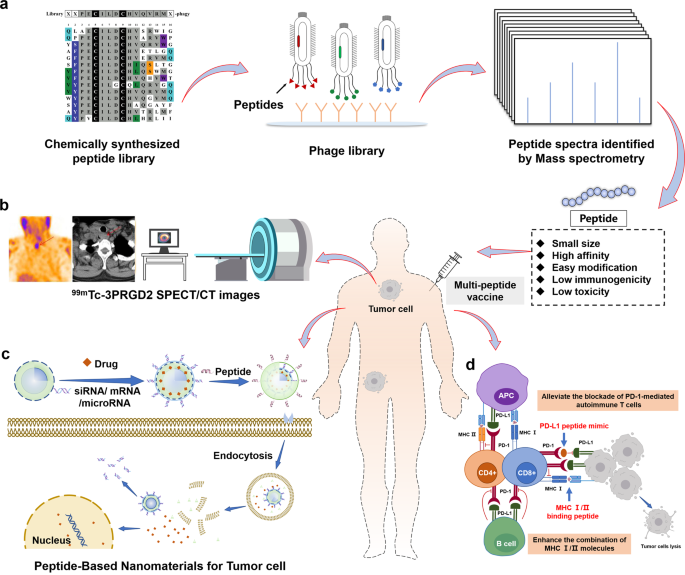
Application of peptides in tumor therapy. a Screening and identification of peptide candidates from chemically synthesized peptide library and phage library. b Using radiolabeled, dye-labeled, or other designed peptides as probes for tumor diagnosis and imaging. c Application of peptide-conjugated nanomaterials in tumor therapy. d Using peptide vaccine and targeting peptides in tumor immunotherapy and targeted therapy
Peptide-based imaging probes bind to receptors specifically expressed in the tumor. These receptors can either be expressed on the cell surface, such as αvβ3 integrin (RGD peptide), EGF receptor, somatostatin receptor, neurotensin receptor, and transferrin receptor; intracellularly, such as Bcr/Abl, cyclin A, and cyclin kinase; or in extracellular matrices, such as fibronectin, matrix metalloproteinases, and prostate-specific antigen. The locations of probes can be visualized by single-photon emission computed tomography/computed tomography scanning to indicate the tumor distribution. This technique has been applied for early tumor diagnosis and surgical resection. Several probes have been developed, such as octreoscan and depreotide, as radiolabeled conjugates of somatostatin-like peptides, have been approved by the FDA for imaging of tumors, such as neuroendocrine tumors and lung cancer. Unfortunately, depreotide has been withdrawn. Radiolabeled peptides based on RGD peptides have recently received attention, and a series of probes have been synthesized, including (99m) Tc-3PRGD2, which can be used to detect differentiated thyroid cancer by negative whole-body scan of radioactive iodine. Lutetium 177 dotatate is a radiolabeled somatostatin analog recently approved for the treatment of somatostatin receptor-positive gastroenteropancreatic neuroendocrine tumors. It binds to somatostatin receptors and then releases radioactive Lutetium 177 into the tumor cells, which induces cellular damage via the formation of intracellular free radicals.
Based on the same principle as peptide-based probes, internal radiotherapy can be achieved by labeling β-emitters on peptides; however, this is notably limited by radiation damage to normal target tissues with positive receptors, either near or far from the tumor. A possible alternative to reduce the potential side effects involves delivering the peptides to tumors coupled to anti-cancer drugs, genes, and RNAs (small interfering RNA (\[siRNA\]/miRNA/mRNA). AN-152 and AN-207 are luteinizing hormone-releasing hormone analogues coupled to adriamycin, with anticancer activity against luteinizing hormone-releasing hormone receptor-positive cancers. The results of phase I and II clinical studies showed that the drug was effective for the treatment of breast cancer, endometrial cancer, and ovarian cancer, with moderate toxicity and side effects. Chen et al. designed PEGylated liposome-polycation-DNA (LPD) nanoparticles and obtained LPD-PEG-NGR by modifying the NGR peptide targeting tumor-specific receptor aminopeptidase N. LPD-PEG-NGR delivered siRNA into solid tumors in mice with systemic, specific, and effective delivery, and by delivering c-myc siRNA, it effectively triggered the apoptosis of tumor cells by down-regulating the expression of c-myc, thus inhibiting the growth of some tumors. In addition, tumor-penetrating peptides screened by phage screening in vivo can effectively deliver covalently coupled and co-administered drugs to the depths of tumor tissues. These results indicate that peptide-based drug delivery systems have important potential for the treatment of tumors.
Antigenic peptides from specific target proteins can act as anticancer peptide vaccines by binding to the major histocompatibility complex (MHC) on antigen-presenting cells, to trigger the anti-tumor effects of helper or cytotoxic T cells. EGFRs, such as EGFR1 and HER2, are well-known targets for cancer treatment. The peptide vaccine TERT572Y, based on the HER2 structure, was used in 46 patients with advanced non-small-cell lung cancer. Subcutaneous injection of TERT572Y induced a TERT-specific immune response and significantly prolonged survival. Manijeh et al. calculated and predicted potential epitopes by PEPOP and selected various peptide sequences from the extracellular domain of HER2 as candidate sequences. They then evaluated the binding affinity of these candidate peptides to MHC I and II molecules by molecular docking, to find the most stable binding structure between peptides and MHC I and II molecules, and selected MHC class I- and II-binding peptides as breast cancer peptide vaccines. However, most clinical trials of peptide vaccines have failed to demonstrate excellent therapeutic effects, and peptide vaccines have thus received little attention. Nevertheless, Takumi et al. argued that the main reason for the lack of success in clinical studies of most cancer vaccines, including peptides, was due to their poor immunogenicity, and suggested that optimization of peptide formulations, adjuvants, and administration routes would achieve ideal results. Peptides, known as cell-penetrating peptides (CPPs), can also be used as drug carriers to transport other peptides, proteins, DNAs, small RNAs, and drugs into cells. The CPP-drug construct comprising nerinetide with the CPP Tat was used to deliver nerinetide across the blood–brain barrier and into neurons. Peptides have also shown a promising delivery function by coupling to antigens to induce antigen-specific immune tolerance and reduce the risk of off-target responses. Tsoras used peptide nanoclusters to improve peptide subunit vaccine immunogenicity for oncofetal antigen.
In addition to being used as drug carriers and vaccines, peptides can also exert anti-tumor effects by binding to target receptors. Among these, the most popular peptides are those targeting the PD-1/PD-L1 signal pathway. Boohaker et al. designed a PD-L1 peptide mimic, PL120131, which can interfere with the interaction of PD-1/PD-L1 by binding to PD-1. PL120131 maintained the survival and activity of co-cultured T cells better than PD-1 antibody in a 3D co-culture model. Based on peptides binding to PD-1 and PD-L1, Zhou et al. designed the self-inhibitory peptides DS-I and DS-II and their cyclic peptide forms, which showed strong affinity to PD-1. Abbas et al. designed a new peptide targeting PD-1, FITC-YT-16, which significantly enhanced the anti-tumor activity of T cells in vitro, while Sasikumar et al. designed the peptide NP-12 to bind PD-L1 competitively with PD-1. Moreover, NP-12 showed the same efficacy as commercial PD-1 targeted antibodies in inhibiting the growth and metastasis of primary tumors in preclinical models of melanoma, colon cancer, and renal cell carcinoma. Although these peptides are not yet suitable for blocking PD-1/PD-L1 to treat tumors, they offer promising potential. Toxic peptides (VPs) from animals may also show an anti-tumor effect. Because VPs naturally target mammalian receptors, they show a high degree of specificity and selectivity for specific ion channels and receptors on the cell membrane. Hanatoxin-1, a peptide toxin isolated from Chilean spiders, specifically blocks the K+ channel on the membrane. High expression of the K+ channel has been observed during the development of colon cancer, and Okada et al. found that the porogenic peptide LaFr26 purified from _Lachesana sp_. spider venom had a cytotoxic effect on the lung cancer cell lines LX22 and BEN, which expressed an endogenous K+ current. Attention has also been paid to the role of AMPs in tumors. Some AMPs have demonstrated anti-tumor activity, while others promoted tumor development. The simplified θ-defensin analogue synthesized by Strzelecka et al. inhibited the growth of breast cancer cells in a 3D culture model, indicating that θ-defensin derivatives have anticancer potential. Anticancer peptides are cationic amphiphilic molecules that preferentially kill cancer cells through folding-dependent membrane rupture. Referring to the membrane-specific interaction of anticancer peptides, Aronson et al. prepared a new class of peptide lipid particles that fuse rapidly with the tumor cell membrane and mediate cell killing, with little toxicity to normal cells, indicating a new tumor-lysis strategy.
Although many peptides have shown the promising anti-tumor effects in preclinical and clinical studies. Only two peptides are currently approved for the treatment of tumors, mifamurtide for osteosarcoma and carfilzomib for multiple myeloma, and research into treatment strategies involving therapeutic peptides for more common tumors, such as lung cancer and gastric cancer, is still ongoing. The key is thus to identify more receptor targets that are specifically expressed in tumor cells and to strengthen their medical translation. In addition, the combination of peptides targeting various tumor receptors is also a potential strategy.
Antiviral peptides
Viruses parasitize all living creatures, including humans, animals, plants, bacteria, and archaea. Humans have always suffered from viral diseases, including Ebola hemorrhagic fever, influenza, and acquired immune deficiency syndrome (AIDS). Despite extensive efforts in antiviral drug development over the past two decades, leading to the approval and clinical use of multiple antiviral drugs, there remains no effective treatment for some of these diseases such as AIDS.
Research into antiviral peptides has become a hot topic, because of the high specificity and activity of peptides. Antiviral peptides act mainly by targeting the virus or its host to block infection. Enfuvirtide, the first approved antiviral peptide, is a 36-amino acid peptide that blocks HIV infection by binding to the heptad-repeat domain of gp41 (HIV envelope protein) to prevent its fusion. In 2011, the antiviral peptide drugs boceprevir and telaprevir were approved for clinical treatment of hepatitis C virus (HCV). They both bind to the HCV NS3/4A serine protease to inhibit protease activity, thus blocking HCV replication in the host. More research on antiviral peptide drug candidates is being undertaken in pre-clinical and clinical studies, including myrcludex B against HBV and HDV, flufirvitide against Influenza virus, and sifuvirtide against HIV-1,.
Since 2020, the respiratory pandemic disease caused by the novel coronavirus SARS-CoV-2 has seriously disturbed people’s lives throughout the world. Scientists have devoted extensive efforts to studying the mechanism of infection of COVID-19 since the start of the pandemic in early 2020, as well as searching for anti-COVID-19 treatments and drugs, including peptide drugs. The COVID-19 genome was rapidly sequenced as an enveloped, positive single-stranded RNA coronavirus with a genome size of about 29.9 kb, which is closely related to bat coronaviruses and the SARS-CoV virus.
Vaccines are commonly considered as effective agents for preventing the spread of pandemic diseases. Vaccines have been approved and used in many countries, including vaccines based on mRNA, recombinant adenoviral vectors, and inactivated vaccines. Peptide vaccines have certain advantages, such as high specificity, good safety, and easier production, and have thus become an active research area in development of vaccines against SARS-CoV-2. Based on the infection mechanism, several research groups have designed and evaluated peptide vaccines against SARS-CoV-2. They used immunoinformatics technology to analyze and identify the key epitopes of B- and T-cell that specifically recognize the spike glycoprotein of SARS-CoV-2. Li et al. and Chakraborty et al. applied the natural epitope sequences as vaccine candidates against SARS-CoV-2. While, Bhattacharya et al. and Waqas tried to construct new peptides as COVID-19 vaccine candidates based on the epitope fragments from B- and T-cell. Similar work has also been carried out by other groups. Herst et al. attempted to design COVID-19 peptide vaccines using the CTL peptide vaccine research platform for Ebola Zaire, and obtained a series of peptide vaccine candidates. Many other studies have focused on blocking the infection process of SARS-CoV-2 using synthetic peptides or nucleotides.
The development of antiviral peptides attracted wide attention during the COVID-19 pandemic, especially the development of peptide vaccines against SARS-CoV-2. Novel technologies, such as immunoinformatics characterization, epitope-based design, in silico identification, and molecular docking have been used expeditiously to design and identify peptide vaccine candidates. Although no peptide vaccines have yet been approved for the treatment of COVID-19, valuable experience has been gained in the development of peptide vaccines, not only against SARS-CoV-2, but also against new viruses in the future.
Source & Further Reading
This page is an original educational paraphrase based primarily on:
Wang, L. et al. Therapeutic peptides: current applications and future directions. Signal Transduction and Targeted Therapy 7, 48 (2022).
Read the original open-access review
This page does not reproduce the source article. It is provided for educational and informational purposes and is not medical advice.