

Quick Answer
Peptide discovery can begin with natural hormones, natural products, biological libraries, display technologies, or rational design. Modern workflows increasingly combine screening with structural and computational approaches. The field has moved from simply isolating natural peptides to engineering them for better potency, selectivity, stability, and manufacturability.
Peptide Drug Discovery
Peptide discovery has evolved from searching for naturally occurring hormones to a broad toolkit that includes natural-product screening, rational design, phage display, and other library technologies. Each route offers a different balance of biological relevance, chemical diversity, and development speed.
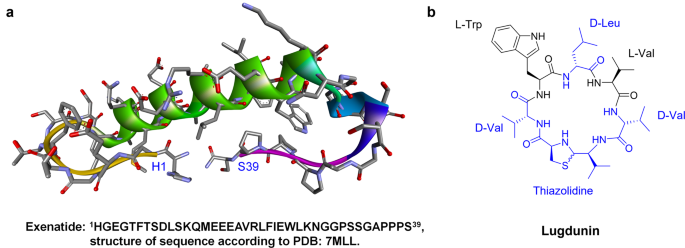
Fig. 1 Sequences and structures of exenatide (a) and lugdunin (b). Natural-product-derived peptides used as therapeutic leads. Source: Wang et al., Signal Transduction and Targeted Therapy (2022) 7:48. Licensed under CC BY 4.0.
Natural hormones as starting points
Some of the earliest peptide medicines were based on naturally occurring hormones with well-understood physiological roles. Insulin, GLP-1, somatostatin, GnRH, vasopressin, and oxytocin are examples discussed in the source review.
This approach is attractive because the biological function of the starting peptide is already understood. The challenge is that a natural peptide may have properties that are unsuitable for therapeutic use, such as rapid degradation or an inconvenient half-life. Natural hormones are often optimized by the body for short-lived signaling rather than for circulation as a drug, so their sequences frequently need to be re-engineered before they can become viable medicines.
A second challenge is selectivity. A natural hormone may act on several receptor subtypes, which can produce both desired effects and unwanted side effects. Discovery teams therefore often need to improve receptor subtype selectivity while preserving the core therapeutic activity.
Hormone-mimetic design
Once a natural sequence is identified, researchers can determine which residues are essential for biological activity and which positions can tolerate modification. This is commonly done through alanine scanning, in which each residue is replaced one at a time to see how the change affects activity.
GLP-1 is a useful example. The natural peptide regulates insulin production and secretion but has a short in-vivo half-life. Sequence and chemical modifications have therefore been used to create more durable GLP-1 receptor agonists, including liraglutide, dulaglutide, and semaglutide. These modifications often involve fatty-acid conjugation, D-amino acid substitution, or other changes that slow enzymatic degradation and extend circulation time.
GnRH-derived medicines demonstrate another form of optimization: changes to the native sequence can preserve receptor-related activity while producing different pharmacological behaviors. Leuprolide acts as a GnRH receptor agonist, whereas degarelix acts as an antagonist, showing how small sequence changes can invert the pharmacological profile.
Natural-product discovery
Peptides can also originate from bacteria, fungi, plants, and animals. Venom peptides are especially valuable sources of biologically active molecules because they can interact with ion channels and membrane receptors with high specificity.
The source review discusses exenatide and ziconotide as examples of clinically relevant peptides connected to natural venom-derived molecules. Exenatide was inspired by a hormone found in Gila monster venom, while ziconotide is derived from the venom of the cone snail Conus magus.
Non-ribosomal peptides provide another discovery space. Their biosynthetic pathways can incorporate non-standard residues and generate structures with properties different from conventional ribosomal peptides. This often gives them greater resistance to proteases and improved in-vivo stability. Well-known examples include vancomycin, cyclosporin, and teixobactin, which have antibacterial or immunosuppressive activities.
Cyclotides and other plant-derived cyclic peptides are also being explored as stable scaffolds for drug discovery, because their disulfide-rich structures resist degradation and can be engineered to carry new binding motifs.
Rational design from protein structures
Structural biology has enabled another route: designing peptides around protein–protein interaction interfaces. These interfaces are often large and flat, making them difficult targets for small molecules but well suited to peptides, which can cover a larger surface area.
Researchers can analyze a protein complex and identify residues that contribute strongly to binding—often called "hotspots." These regions can then provide a template for peptide design. If the hotspots are contiguous, a linear peptide fragment may be enough; if they are dispersed, linking strategies or scaffold-based approaches may be needed.
The resulting candidates may be further optimized through sequence substitution, cyclization, stapling, and other structural modifications. Computational tools such as molecular dynamics simulations and docking are increasingly used to predict binding modes and guide these optimizations.
Phage display
Phage display is a library-based method for identifying ligands against biological targets. The technology uses recombinant methods to present peptides on bacteriophage particles, allowing large libraries to be screened. Each phage carries a displayed peptide and the DNA encoding it, so selected binders can be recovered and sequenced.
The review describes applications of phage display in identifying peptide ligands for targets including GLP-1-related receptors, TGF-β1, EGFR, and other signaling systems. Because libraries can contain billions of variants, phage display can explore sequence space far beyond what rational design alone can cover.
Later developments expanded the discovery toolkit to include chemically modified peptides, mirror-image phage display, mRNA display, and ribosomal display. Mirror-image phage display enables the discovery of D-peptide ligands, which are more resistant to proteolysis. mRNA and ribosomal display allow the incorporation of unnatural amino acids, broadening the chemical and structural space accessible during discovery.
Screening libraries and high-throughput methods
Beyond phage display, other library technologies have become important discovery tools. These include:
- Synthetic peptide libraries built by combinatorial chemistry, which allow rapid exploration of sequence variants.
- mRNA display and ribosomal display, which link genotype and phenotype without living cells.
- DNA-encoded libraries (DELs), which allow very large compound collections to be screened in a single experiment.
- Cell-based screening, which evaluates peptides in a more physiological context and can capture effects such as receptor activation or internalization.
Each method has trade-offs. Display technologies offer very large libraries but can be biased toward certain sequences. Cell-based screens are more physiological but usually lower throughput. Discovery programs often combine several approaches to balance coverage and relevance.
From hit to candidate
Discovery is only the beginning. A promising sequence still has to be evaluated for potency, selectivity, stability, physicochemical behavior, and manufacturability. Early hits often have modest activity and need multiple rounds of optimization.
This creates a pipeline in which screening, structural analysis, medicinal chemistry, synthesis, and biological testing are closely connected. Failures at any stage—poor solubility, rapid clearance, off-target activity, or difficult synthesis—can eliminate a candidate even if it binds its target well.
The later stages of discovery increasingly overlap with development. Formulation, delivery route, and manufacturing feasibility are now often considered early, because they can shape which candidates are worth pursuing.
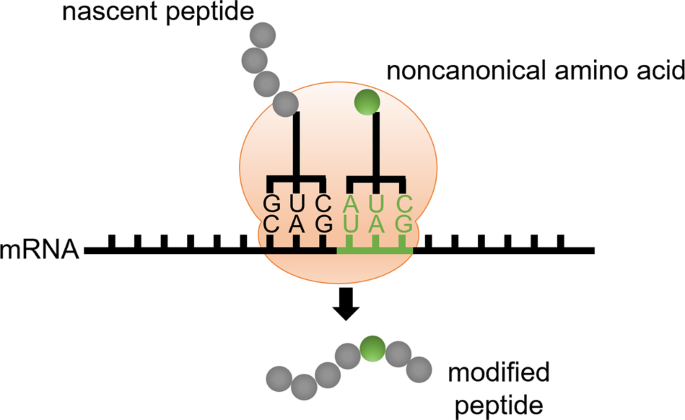
Fig. 2 Scheme of genetic code expansion, enabling site-specific incorporation of a noncanonical amino acid into a growing peptide chain. This technology expands the chemical space available for peptide discovery and optimization. Source: Wang et al., Signal Transduction and Targeted Therapy (2022) 7:48. Licensed under CC BY 4.0.
Computational and AI-assisted discovery
Computational methods are playing an increasing role in peptide discovery. Structure prediction tools can generate models of peptide–target complexes, and machine-learning models can prioritize sequences for synthesis and testing.
These tools do not replace experimental screening, but they can reduce the number of candidates that need to be made and tested. They are especially useful when structural information is available, or when large datasets of binding or activity measurements can be used to train predictive models.
Key takeaway
Modern peptide discovery is no longer a single method. It is a combination of biological insight, library screening, structural biology, computational analysis, and chemical synthesis. This diversity is one reason peptide therapeutics can address a wide range of biological targets, from hormones and receptors to protein–protein interactions that are difficult to drug with small molecules.
Source & Further Reading
This page is an original educational paraphrase based primarily on:
Wang, L. et al. Therapeutic peptides: current applications and future directions. Signal Transduction and Targeted Therapy 7, 48 (2022).
Read the original open-access review
This page does not reproduce the source article. It is provided for educational and informational purposes and is not medical advice.