

Quick Answer
The history of peptide medicines progressed from natural hormone replacement to recombinant production, synthetic chemistry, molecular optimization, display technologies, and rational peptide design.
History of Peptide Drugs
The development of peptide medicines has evolved from the isolation of natural hormones to sophisticated approaches involving recombinant production, chemical synthesis, structural modification, and computational design.
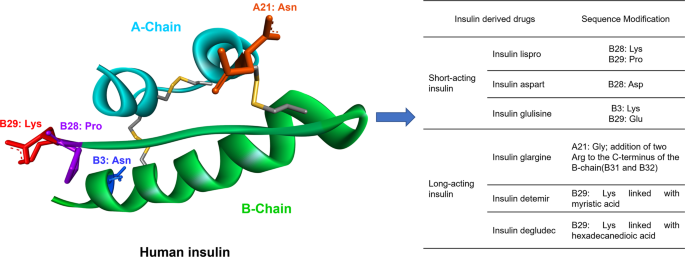
Structure of human insulin and human insulin-derived drugs. Structure of human insulin (left, PDB: 1XDA). Modifications on its residues (B-Chain: B3: Asn, B28: Pro, B29: Lys; A-Chain: A21: Asn) resulted in several short- and long-acting insulin drugs (right, see table)
The insulin milestone
Insulin is one of the foundational examples in peptide therapeutics. The review by Wang et al. describes insulin as a 51-amino-acid peptide and highlights its discovery in the early 20th century as a landmark in drug development. Insulin became the first commercial peptide drug in the early 1920s.
Early insulin production relied heavily on animal-derived material. Later advances in biotechnology made recombinant human insulin possible, providing a major transition from extraction-based production to biological manufacturing.
Expansion through peptide hormones
From the 1950s through the 1990s, researchers identified and characterized additional peptide hormones and receptors with therapeutic potential. Improved protein purification, synthesis, sequencing, and structural-analysis technologies helped expand the peptide-drug field.
Natural hormones such as GLP-1, somatostatin, GnRH, vasopressin, and oxytocin provided important templates for drug discovery. However, natural sequences often required optimization before they could become practical medicines.
The era of peptide analogues
A major development was the deliberate modification of natural peptide sequences. GLP-1 provides a useful example: the natural peptide is biologically active but has a very short half-life. Medicinal chemistry therefore focused on modifications that could improve stability while preserving receptor activity.
The review describes GLP-1-derived drugs including liraglutide and discusses the development of several widely used GLP-1 receptor agonists. This illustrates a recurring pattern in peptide drug development: identify a biologically useful peptide, determine which structural elements are essential, and then optimize the molecule for therapeutic use.
GnRH provides another example. Modifying the native ten-amino-acid sequence produced drugs with different receptor behaviors, including agonist and antagonist approaches.
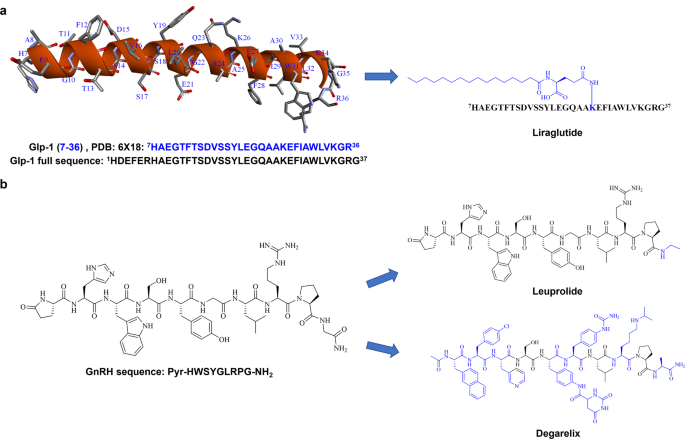
Sequences and structures of natural hormones GLP-1 and GnRH and their peptidomimetic drugs. a Liraglutide is a GLP-1 derived peptide drug, modified on 26th residue (K) of its natural sequence. b Leuprolide and degarelix are modified from the natural sequence of GnRH
Peptides from nature
The history of peptide therapeutics is not limited to human hormones. Researchers have explored bioactive peptides from animals, plants, fungi, and bacteria.
Venom-derived peptides are particularly interesting because they can interact with ion channels and other membrane-associated targets. The review discusses examples such as exenatide, which was developed from a peptide associated with Gila monster venom, and ziconotide, derived from the cone snail Conus magus.
Non-ribosomal peptides represent another natural-product class. Their unusual amino-acid chemistry can give them properties that differ from conventional ribosomally produced peptides.
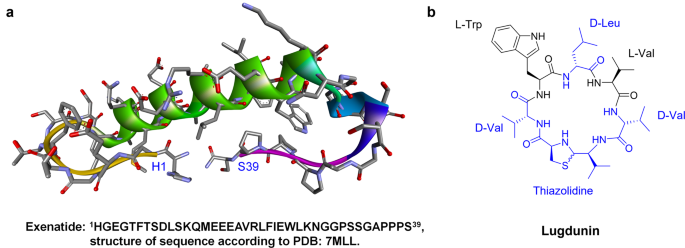
Sequences and structures. Exenatide (a) and lugdunin (b)
Modern peptide discovery
In the 21st century, peptide discovery increasingly combines structural biology, recombinant technologies, chemical synthesis, screening libraries, and analytical methods. Phage display, for example, can be used to identify peptide ligands against biological targets. Other display technologies have expanded access to macrocyclic peptides and molecules containing non-standard residues.
The modern field therefore looks very different from the early era of peptide extraction. Today's peptide candidates can be discovered from natural products, generated from biological libraries, designed from structural information, or assembled through synthetic chemistry.
Key takeaway
The history of peptide drugs is essentially a story of progressive control over peptide structure and production. Natural hormones provided the initial templates; recombinant and synthetic technologies improved manufacturing; medicinal chemistry extended stability and selectivity; and modern screening and structural approaches have broadened the range of possible peptide medicines.
Source & Further Reading
This page is an original educational paraphrase based primarily on:
Wang, L. et al. Therapeutic peptides: current applications and future directions. Signal Transduction and Targeted Therapy 7, 48 (2022).
Read the original open-access review
This page does not reproduce the source article. It is provided for educational and informational purposes and is not medical advice.