

Cagrilintide is an investigational long-acting synthetic analog of human amylin, designed to activate amylin receptors involved in appetite regulation and metabolic control. Developed as a potential therapy for obesity and type 2 diabetes, cagrilintide is most notably studied in combination with semaglutide (CagriSema), representing a strategy to engage complementary metabolic pathways beyond GLP-1 signaling alone.
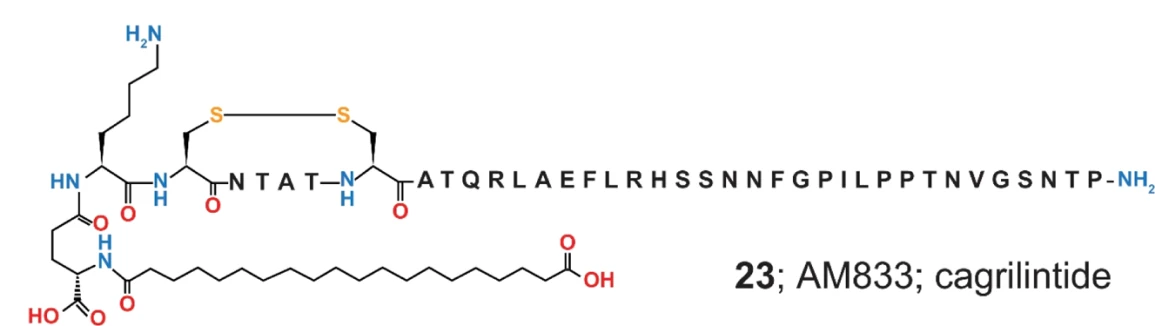
What Is Cagrilintide?
Cagrilintide is a synthetic peptide analog of human amylin, a hormone co-secreted with insulin by pancreatic beta cells in response to food intake. While amylin itself has a very short half-life, cagrilintide was engineered for prolonged action suitable for once-weekly subcutaneous dosing.
Amylin receptor activation contributes to meal-ending satiety signals, slowing gastric emptying and reducing food intake through actions in the brainstem and hypothalamus. Unlike GLP-1 receptor agonists, which primarily dampen orexigenic drive across the feeding window, amylin agonism acts more as a meal-termination signal, strengthening the "stop" side of the appetite balance.
This distinct mechanism makes cagrilintide an important subject in next-generation peptide research, particularly in combination strategies.
Why Is Cagrilintide Different?
The development of metabolic peptide therapeutics has progressed from single-receptor agonists toward combinations that engage multiple signaling pathways.
A simplified development concept is:
GLP-1 receptor agonist ↓ Semaglutide
Amylin receptor agonist ↓ Cagrilintide
Amylin + GLP-1 receptor combination ↓ CagriSema
This does not mean the molecules are interchangeable. Each peptide targets structurally distinct receptors with different signaling cascades and distribution patterns. The combination of cagrilintide and semaglutide (CagriSema) was designed to leverage complementary mechanisms: GLP-1 agonism for sustained appetite suppression and amylin agonism for enhanced post-meal satiety.
How Does Cagrilintide Work?
1. Amylin Receptor Activation
Amylin receptors are heterodimers formed by the calcitonin receptor (CTR) and receptor activity-modifying proteins (RAMP1/2/3). Cagrilintide acts as a dual amylin and calcitonin receptor agonist, with activity across amylin receptor subtypes.
Amylin receptor signaling is associated with:
- Meal-ending satiety
- Slowing of gastric emptying
- Suppression of glucagon secretion
- Reduced food intake
2. Neural Mediators of Cagrilintide Action
Recent research has begun to map the specific neural populations mediating cagrilintide's effects. A 2026 cross-species study generated a transcriptomic atlas of the dorsal vagal complex (DVC) across rat, mouse, and macaque, identifying two conserved Calcr-expressing neuronal populations in the brainstem.
Long-term cagrilintide treatment upregulated prolactin-releasing hormone (Prlh) expression in nucleus of the solitary tract Calcr/Prlh cells. Knocking down DVC Prlh abolished cagrilintide's effects on energy balance, identifying these neurons as key mediators of amylin receptor agonist action.
3. Brain Circuit Effects
Functional MRI studies in adults with overweight or obesity have shown that CagriSema modified brain responses to high-calorie food cues in regions linked to cravings, reward, sensory processing, and behavioral control. Treatment substantially reduced 'food noise'—persistent thoughts about food—cravings, hunger, and appetite at 22 and 52 weeks.
These findings suggest that amylin-based therapies may address biological drivers of eating behavior beyond simple calorie restriction.
The CagriSema Concept
CagriSema is a fixed-dose combination of cagrilintide (2.4 mg) and semaglutide (2.4 mg) administered as a once-weekly subcutaneous injection. The rationale for combining these two molecules is based on their complementary mechanisms.
A simplified model is:
| Receptor | Major biological role |
|---|---|
| Amylin receptor (with cagrilintide) | Meal-ending satiety, gastric emptying, glucagon suppression |
| GLP-1R (with semaglutide) | Glucose-dependent insulin secretion, appetite regulation, delayed gastric emptying |
The challenge in combining amylin and GLP-1 receptor agonists is not simply activating both pathways, but managing the additive gastrointestinal effects that both mechanisms can produce. Clinical trials have consistently shown higher rates of gastrointestinal adverse events with the combination compared to either monotherapy, though these are generally mild to moderate and transient.
Cagrilintide Molecular Structure
Cagrilintide is a synthetic peptide engineered for prolonged pharmacological activity. It is a long-acting amylin analog with a half-life of approximately 168 to 192 hours (7-8 days), supporting once-weekly dosing.
The molecular design incorporates structural modifications intended to:
- Enhance proteolytic stability
- Extend circulating half-life
- Maintain amylin receptor activity
- Optimize the balance between amylin and calcitonin receptor activity
The extended half-life distinguishes cagrilintide from native amylin and allows for convenient once-weekly administration in clinical settings.
Cagrilintide and Obesity Research
Obesity has been a major area of clinical research for cagrilintide, both as monotherapy and in combination with semaglutide.
A Phase 2 dose-finding trial of cagrilintide monotherapy (published in The Lancet) evaluated once-weekly cagrilintide for weight management in adults with overweight or obesity, examining weight reduction over 26 weeks.
The most robust data come from the CagriSema Phase 3 program. The REDEFINE 1 trial evaluated once-weekly CagriSema (2.4 mg/2.4 mg) in 3,417 adults with obesity or overweight without diabetes over 68 weeks. CagriSema produced mean weight loss of 20.4%, compared with 3.0% for placebo. When evaluating treatment effect irrespective of treatment discontinuation, weight loss reached 22.7%.
A systematic review and meta-analysis confirmed that CagriSema achieves greater weight loss than semaglutide or placebo, while noting increased gastrointestinal adverse events.
Cagrilintide and Type 2 Diabetes Research
Cagrilintide has also been investigated in people with type 2 diabetes, primarily as part of CagriSema.
The REDEFINE 2 trial evaluated once-weekly CagriSema (2.4 mg/2.4 mg) versus placebo in 1,206 adults with type 2 diabetes and obesity or overweight over 68 weeks. CagriSema produced mean weight loss of 13.7% compared with 3.4% for placebo. Notably, 74% of CagriSema-treated participants achieved HbA1c ≤6.5%, compared with 15.9% for placebo.
The REIMAGINE 2 trial compared CagriSema 2.4/2.4 mg with semaglutide 2.4 mg and cagrilintide 2.4 mg alone in 2,713 adults with type 2 diabetes. CagriSema reduced HbA1c by 1.91 percentage points versus 1.75 for semaglutide (difference -0.16, p=0.0035) and body weight by 14.2% versus 10.2% for semaglutide.
These findings support continued investigation of the amylin-GLP-1 combination approach for type 2 diabetes.
Pharmacokinetic Considerations
Long-acting peptide therapeutics require careful optimization of pharmacokinetic characteristics.
For cagrilintide, the half-life of approximately 7-8 days supports once-weekly administration. A dedicated pharmacokinetic study (NCT04940078) compared blood levels of cagrilintide and semaglutide when administered as separate injections versus a combined single injection in adults with overweight or obesity, evaluating whether co-administration alters the pharmacokinetic profiles of either component.
The pharmacokinetic design of a combination product is important because both components need to maintain therapeutically appropriate exposure over the dosing interval. If one component is cleared more rapidly than the other, the balance of effects may shift over time.
From a peptide engineering perspective, several development objectives apply:
- Maintain sufficient systemic exposure
- Preserve amylin and calcitonin receptor activity
- Control peptide degradation
- Optimize dosing intervals for both components
- Minimize injection volume for combination administration
Cagrilintide vs. Semaglutide vs. Tirzepatide
Cagrilintide is often discussed alongside semaglutide and tirzepatide because all belong to the broader field of metabolic peptide therapeutics, though they target different receptor systems.
| Peptide | Primary Target | Key Mechanism | Combination |
|---|---|---|---|
| Semaglutide | GLP-1R | Incretin signaling, appetite regulation | — |
| Tirzepatide | GIPR + GLP-1R | Dual incretin agonism | — |
| Cagrilintide | Amylin/calcitonin receptors | Satiety, gastric emptying | CagriSema (with semaglutide) |
A key distinction: cagrilintide is not typically used as monotherapy in advanced clinical development, but rather as a component of the CagriSema combination. This reflects the strategy of engaging complementary rather than redundant pathways.
In the REIMAGINE 5 trial, CagriSema 1.0/1.0 mg demonstrated superior weight loss versus tirzepatide 5 mg (12.4% vs 9.1%) in adults with type 2 diabetes, though direct comparisons across different doses and populations require careful interpretation.
Current Research Directions
Multi-Receptor Combination Strategies
One major research question is how amylin and GLP-1 receptor agonism interact to produce their combined effects. Ongoing studies are investigating the metabolic effects of CagriSema versus diet-induced weight loss, including changes in energy expenditure, resting metabolic rate, and substrate utilization.
Cardiovascular Outcomes
The REDEFINE 3 trial is evaluating CagriSema (2.4/2.4 mg) versus placebo in 7,076 adults with established cardiovascular disease and BMI ≥25 kg/m². The primary safety objective is noninferiority on major adverse cardiovascular events (MACE-3), with efficacy assessed on MACE-4 (including revascularization). This represents a critical step in understanding whether amylin-based therapies provide cardiovascular benefits beyond weight loss.
Metabolic Organ Effects
Emerging data suggest that CagriSema may influence disease biology across multiple organs. A diabetes MRI sub-study in the REIMAGINE 1 trial showed significant reductions in abdominal, perihepatic, and pancreatic fat versus placebo alongside 14.3% body-weight reduction at week 40. A post hoc analysis of bone markers in REIMAGINE 2 showed signs of healthy bone maintenance balance alongside 14.2% weight reduction.
Tolerability in GLP-1 Intolerant Patients
A Phase 2 feasibility study (NCT07607587) is evaluating cagrilintide tolerability in participants with overweight or obesity who discontinued GLP-1 receptor agonist therapies due to gastrointestinal adverse events. This study will assess whether amylin-based therapy might offer an alternative for this population.
Cagrilintide Research Materials
For organizations conducting peptide characterization, analytical research, formulation studies, or other laboratory projects, cagrilintide can serve as a representative example of a long-acting amylin analog.
Research materials should be evaluated according to:
- Identity
- Purity
- Analytical documentation
- Batch information
- Storage requirements
- Intended research application
Because cagrilintide remains an investigational compound, research material should be clearly distinguished from an approved therapeutic product.
Conclusion
Cagrilintide represents an important development in the evolution of amylin-based peptide therapeutics.
Its defining feature is selective activation of amylin receptors, creating a pharmacological approach that complements rather than duplicates GLP-1 receptor signaling. When combined with semaglutide as CagriSema, the two mechanisms produce greater weight loss and glycemic improvement than either component alone.
Clinical Phase 3 studies have provided evidence of substantial effects on body weight and HbA1c, while identifying gastrointestinal adverse events as an important aspect of the safety profile. The REDEFINE 3 cardiovascular outcomes trial will be critical for understanding whether these metabolic benefits translate to cardiovascular risk reduction.
For peptide researchers, cagrilintide is particularly relevant as a case study in:
- Amylin receptor pharmacology
- Long-acting peptide engineering
- Combination peptide therapeutics
- Neural mechanisms of appetite regulation
- Multi-target metabolic drug design
- Next-generation obesity and diabetes research
As clinical development continues, further studies will help clarify the long-term efficacy, safety, and potential applications of this emerging peptide platform.
References
- Ludwig MQ, et al. A cross-species atlas of the dorsal vagal complex reveals neural mediators of the effects of cagrilintide on energy balance. Nature Metabolism. 2026;8(6):1350-1367. https://pubmed.ncbi.nlm.nih.gov/42260119/
- Garvey WT, et al. Cagrilintide–Semaglutide in Adults with Overweight or Obesity (REDEFINE 1). New England Journal of Medicine. 2025;393:648-659.
- Davies MJ, et al. Cagrilintide–semaglutide in adults with overweight or obesity and type 2 diabetes (REDEFINE 2). New England Journal of Medicine. 2025;393:648-659.
- Lau DCW, et al. Once-weekly cagrilintide for weight management in people with overweight and obesity: a multicentre, randomised, double-blind, placebo-controlled and active-controlled, dose-finding phase 2 trial. The Lancet. 2021;398:2160-2172.
- Frias JP, et al. Efficacy and safety of co-administered once-weekly cagrilintide 2.4 mg with once-weekly semaglutide 2.4 mg in type 2 diabetes: a multicentre, randomised, double-blind, active-controlled, phase 2 trial. The Lancet. 2023;402:720-730.
- Novo Nordisk. REIMAGINE 5 and REDEFINE 9 topline results. 2026.
- Novo Nordisk. CagriSema brain and body data at EASD 2026.
- ClinicalTrials.gov. CagriSema cardiovascular outcomes trial (REDEFINE 3). NCT05669755.
- ClinicalTrials.gov. Cagrilintide tolerability in GLP-1 intolerant patients. NCT07607587.
- ClinicalTrials.gov. Cagrilintide and semaglutide pharmacokinetics. NCT04940078.
Disclaimer: This article is provided for scientific and educational purposes only. Cagrilintide is an investigational compound and should not be presented as an approved treatment. This article does not provide medical advice or recommendations for dosing, self-administration, purchase, or treatment.